Variable speed belt sanders give you more control than fixed-speed models, making it easier to move from aggressive material removal to cleaner finishing work.
In this roundup, we focused on balanced performance, comfort, dust collection, and the kind of speed control that actually helps on real projects.
Best 10 Variable Speed Belt Sanders Picks for 2026
2-in-1 Workshop Pick
WEN 10-Amp Variable Speed Combo Belt Sander

- 10-amp motor with 660-1310 FPM speed range
- Converts from handheld to upward-facing benchtop use
- Includes dust bag, clamps, mounting pad, and 2 belts
Best For: Shoppers who want one sander for handheld and stationary jobs
Compact Control Choice
Jellas 7-Amp Variable Speed 3x21 Belt Sander

- 6-dial variable-speed knob for task matching
- Can be clamped to a table for bench use
- Includes 10 belts, dust bag, and vacuum adapter
Best For: DIYers who want a compact sander with variable speed and dust collection
Pressure-Control Pick
SKIL 6-Amp 3x18 Belt Sander with Dust Control

- Pressure control warns against excessive force
- Auto track belt alignment helps keep sanding centered
- Micro-filtration and vacuum compatibility reduce dust
Best For: Users who want compact sanding with better pressure and dust management
Long-Reach Woodworking Pick
Jellas 7-Amp 3x21 Variable Speed Belt Sander
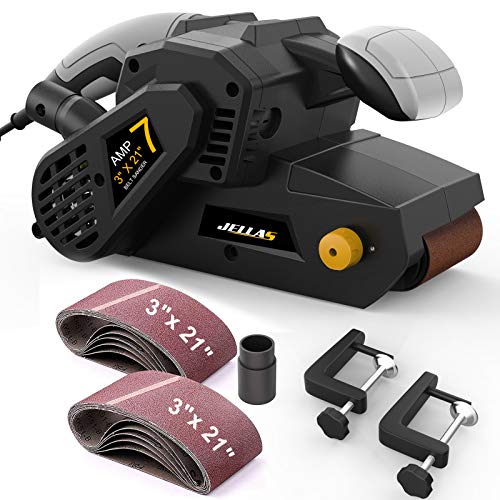
- 6-dial variable-speed control for task matching
- 10-foot cord adds reach and flexibility
- Includes 10 belts, dust bag, and vacuum adapters
Best For: Woodworkers who want extra cord reach and a versatile belt assortment
Compact Detail Sander
WEN 6307 Variable Speed Detailing File Sander
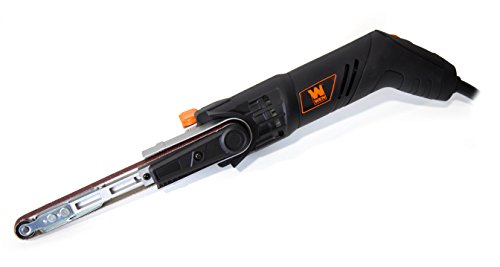
- Variable speed from 1080 to 1800 FPM
- Auto-tracking belt needs no adjustments
- 50° pivot helps with detailed sanding
Best For: Fine-detail sanding and compact edge work
General-Purpose Belt Sander
WEN 6321 7-Amp 3 x 21 Corded Belt Sander
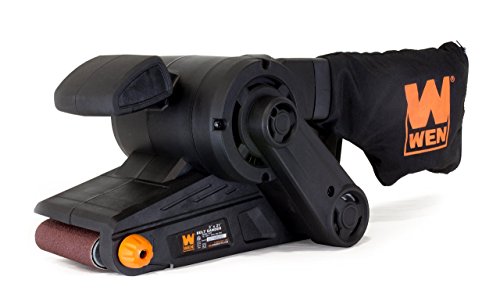
- 7-amp motor runs belt over 13 ft/sec
- Lightweight at about six pounds
- Dust bag and lock-in feature add convenience
Best For: General sanding and material removal tasks
Knife-Making Variable Speed Grinder
1x30 Variable Speed Belt Sander with KSAG-5

- VFD provides smooth variable speed control
- Forward/reverse belt direction aids control
- Includes KSAG-5 angle guide for bevels
Best For: Knife making and precision grinding work
Benchtop Combo Sander
WEN 6502T 4 x 36 Belt / 6 in. Disc
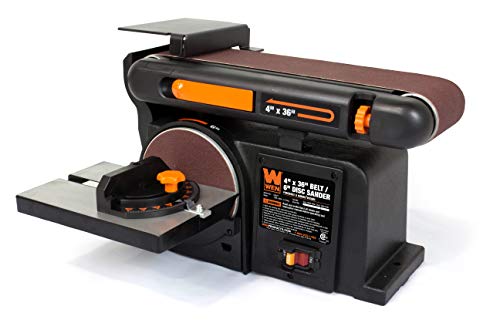
- 4-by-36 inch belt plus 6-inch disc
- Belt tilts 0 to 90 degrees
- Cast iron base helps reduce vibration
Best For: Shop users who want a stable two-in-one sanding station
Variable-Speed Belt Sander
Metabo HPT SB8V2 3 x 21 Variable Speed

- Variable speed dial for control
- 9 amp motor for tougher sanding
- Dust bag and clear front cover
Best For: Users who want strong corded sanding power with adjustable speed
Portable Variable-Speed Sander
WEN HB321V 3 x 21 Handheld Variable Speed

- 7.5-amp motor with variable speed
- Lightweight 6.4-pound handheld design
- Dust bag, dust port, and lock-on switch
Best For: DIYers who want a lightweight adjustable-speed belt sander
2-in-1 Workshop Pick – WEN 10-Amp Variable Speed Combo Belt Sander
WEN 10-Amp 4-by-24-Inch Variable Speed Combination Handheld and Benchtop Belt Sander (HB424V)
Check Price On AmazonIf you want one of the more versatile variable speed belt sanders for home woodworking, this WEN model stands out because it works as both a handheld sander and an upward-facing benchtop unit. The 10-amp motor gives you a wide speed range from 660 to 1310 feet per minute, which is useful when you need more control for different sanding tasks.
Best For: Users who want a corded 2-in-1 belt sander for both handheld use and stationary bench work.
Pros:
- Variable-speed motor lets you dial sanding from 660 to 1310 feet per minute.
- Converts into an upward-facing stationary sander with clamps and a rubber mounting pad.
- Quick-release belt tension lever makes belt changes easier.
- Includes a detachable dust bag, dust port, two 80-grit belts, and a two-year warranty.
Cons:
- Corded design means you’ll need to work near power.
- The included belts are only 80-grit, so other grits may need to be purchased separately.
Overall, this is a practical pick if you want flexibility more than specialty features. Its handheld-to-benchtop setup makes it a strong fit for general sanding jobs where adaptability matters.
Compact Control Choice – Jellas 7-Amp Variable Speed 3×21 Belt Sander
This Jellas model is a useful choice if you’re comparing variable speed belt sanders for woodworking and want a compact 3 x 21-inch format with added control. The 7-amp motor and 6-dial variable-speed knob are designed to match speed to the task, while the included dust bag and vacuum adapter help keep cleanup manageable.
Best For: Woodworkers who want a handheld belt sander with variable speed and easy dust collection.
Pros:
- 6-dial variable-speed control helps match sanding speed to the application.
- Can be flipped and clamped to a table for bench-style use.
- Comes with 10 sanding belts in multiple grits for different projects.
- Includes a detachable dust bag, vacuum adapter, and a 10-foot power cord.
Cons:
- Speed range is listed as 120-400 rpm, which is relatively modest.
- Corded operation limits mobility compared with battery-powered tools.
For small- to medium-sized sanding jobs, this model offers a solid balance of control and convenience. The extra belt assortment and dust setup make it easy to get started on woodworking tasks right away.
Pressure-Control Pick – SKIL 6-Amp 3×18 Belt Sander with Dust Control
If your priority is control rather than raw size, this SKIL belt sander is a strong candidate among variable speed belt sanders alternatives for wood sanding work. It uses pressure control technology to warn you when you’re pressing too hard, and its auto-track system helps keep the belt centered while you work.
Best For: Woodworkers who want a compact belt sander with pressure feedback and dust control.
Pros:
- Pressure control technology warns when too much force is applied.
- Auto track belt alignment helps keep the belt centered.
- Micro-filtration dust collection and vacuum compatibility support cleaner sanding.
- Flush-edge sanding helps reach tight edges.
Cons:
- Does not advertise variable-speed adjustment in the supplied details.
- 3 x 18-inch size is more compact than larger belt sanders.
This is a practical pick if you care about cleaner results and better pressure awareness. It’s especially useful for general wood sanding where edge access and dust management matter.
Long-Reach Woodworking Pick – Jellas 7-Amp 3×21 Variable Speed Belt Sander
This Jellas 3 x 21-inch sander is another practical option if you’re shopping for variable speed belt sanders with a focus on control, dust handling, and comfort. It uses a 7-amp motor with a 6-dial variable-speed knob, and the 10-foot power cord gives you extra reach for larger work areas.
Best For: Woodworkers who want a corded belt sander with variable speed, long reach, and included belt assortment.
Pros:
- 6-dial variable-speed control helps match speed to the job.
- Can be clamped to a table for bench-style sanding.
- Includes 10 sanding belts in multiple grits for different tasks.
- 10-foot power cord and soft grip handle improve reach and comfort.
Cons:
- Speed range is listed as 120-400 rpm, which may feel limited for some users.
- Corded design means it is less portable than battery tools.
With its longer cord and included accessories, this version is well suited to project work that needs flexibility without extra setup hassle. The bench conversion and dust-bag design make it a handy all-around woodworking tool.
Compact Detail Sander – WEN 6307 Variable Speed Detailing File Sander
If you need a variable speed belt sander for detailed work, the WEN 6307 is built around control and reach. Its 1/2-by-18-inch belt, pivoting head, and auto-tracking design make it a practical choice for sanding in tighter spaces, shaping edges, and handling smaller project areas without constant adjustment.
Best For: Fine-detail sanding, edge work, and users who want a lightweight variable-speed tool for compact tasks.
Pros:
- Variable speed dial runs from 1080 to 1800 feet per minute
- Auto-tracking belt system requires no tensioning or adjustments
- 50° pivot range helps the belt meet different project angles
- Tool-free belt changes make mid-job swaps quicker
Cons:
- Small 1/2-by-18-inch belt is better for detail work than large surface removal
- Includes only three sanding belts to start
- Corded design limits portability compared with cordless options
Overall, this WEN model is a strong fit when precision matters more than aggressive stock removal. It focuses on ease of use, compact handling, and adjustable speed rather than brute force.
General-Purpose Belt Sander – WEN 6321 7-Amp 3 x 21 Corded Belt Sander
For shoppers comparing variable speed belt sanders, the WEN 6321 is a straightforward corded option built for everyday sanding jobs. Its 7-amp motor, 3 x 21-inch belt, and compact body make it a practical pick for smoothing surfaces, removing material, and handling general workshop sanding tasks.
Best For: Everyday sanding, surface cleanup, and users who want a simple corded belt sander for general projects.
Pros:
- 7-amp motor drives the belt at over 13 feet per second
- Weighs about six pounds for easier handling
- Detachable dust bag helps reduce cleanup
- Lock-in safety feature supports continuous sanding
Cons:
- Does not offer variable speed control
- Corded design limits mobility around the workspace
- Best suited to general sanding rather than precision detail work
This model is a solid no-frills choice if you want a dependable belt sander for common tasks. It emphasizes simplicity, manageable weight, and steady sanding performance over advanced controls.
Knife-Making Variable Speed Grinder – 1×30 Variable Speed Belt Sander with KSAG-5
This variable speed belt sander is aimed at precision grinding and sharpening rather than broad sanding jobs. The 1×30 setup, forward/reverse belt direction, and VFD speed control make it useful for bevel work, polishing, finishing, and knife-making tasks where control matters.
Best For: Knife making, bevel grinding, sharpening, and metalworking projects that need flexible belt direction and speed control.
Pros:
- Variable Frequency Drive provides smooth speed adjustment
- Forward and reverse belt direction improves control and visibility
- Includes KSAG-5 angle guide for repeatable bevel grinding
- All-steel construction is built for rigidity and durability
Cons:
- More specialized than a general-purpose belt sander
- 5-amp, corded design may not suit heavy production users
- Setup is geared toward workshop grinding and sharpening tasks
Compared with basic sanding tools, this model is much more focused on controlled grinding work. It stands out for its speed adjustment, direction reversal, and included angle guide, all of which help produce consistent results.
Benchtop Combo Sander – WEN 6502T 4 x 36 Belt / 6 in. Disc
WEN Benchtop Belt and Disc Sander with 4 x 36 in. Belt, 6 in. Disc and Cast Iron Base (6502T)
Check Price On AmazonIf you want a practical variable speed belt sanders alternative in a benchtop format, the WEN 6502T gives you both belt and disc sanding in one compact machine. The 4-by-36 inch belt tilts from 0 to 90 degrees, and the 6-inch disc adds extra flexibility for shaping and smoothing across different tasks.
Best For: Woodworkers who want a stable two-in-one benchtop sander for general shop use.
Pros:
- Two-in-one design combines a 4-by-36 inch belt with a 6-inch disc.
- Belt tilts anywhere from 0 to 90 degrees for more sanding positions.
- Cast iron base helps prevent heavy vibrations.
- Tension release lever simplifies sandpaper grit changes.
Cons:
- It is a corded benchtop machine, so it is not portable.
- The motor is rated for 3600 RPM, but there is no variable speed control listed.
This is a solid pick if you want one stationary sander to handle a range of shop sanding jobs without adding extra tools. Its strength is stability and versatility, not portability or speed adjustment.
Variable-Speed Belt Sander – Metabo HPT SB8V2 3 x 21 Variable Speed
For buyers comparing variable speed belt sanders, the Metabo HPT SB8V2 stands out for its 9 amp motor and speed control dial built into the handle base. It is designed for woodworking tasks that need more manageability, while the clear front cover and left-side dust bag help improve visibility and dust handling during sanding.
Best For: Woodworkers who want a corded belt sander with variable speed control and strong sanding power.
Pros:
- Variable speed dial supports different applications and better control.
- 9 amp, 1,020-watt motor provides strong power for tougher jobs.
- Clear front cover improves visibility when sanding near surfaces.
- Dust collection bag helps reduce airborne particles and keep the work area cleaner.
Cons:
- Only one sanding belt is included in the box.
- It is corded, so it is not meant for cordless use.
This model is a good fit if you want more control than a fixed-speed sander can offer. The combination of variable speed, strong motor output, and practical dust collection makes it a capable woodworking option.
Portable Variable-Speed Sander – WEN HB321V 3 x 21 Handheld Variable Speed
WEN 7.5-Amp 3-by-21-Inch Variable Speed Handheld Portable Belt Sander (HB321V)
Check Price On AmazonIf you need a handheld option in the variable speed belt sanders category, the WEN HB321V focuses on portability and simple control. Its 7.5-amp motor runs the belt from 620 to 1200 feet per minute, while the compact 6.4-pound design and lock-on switch make longer sanding sessions easier to manage.
Best For: DIY users who want a lightweight handheld belt sander with variable speed and easy handling.
Pros:
- Variable speed motor lets you adjust the belt from 620 to 1200 feet per minute.
- Light 6.4-pound design helps limit user fatigue.
- Lock-on power switch supports continuous sanding without constant trigger pressure.
- Includes a detachable dust bag, 1-1/4-inch dust port, and 80-grit sanding belt.
Cons:
- It is a handheld corded sander, so it still needs an outlet.
- There is no mention of advanced dust collection beyond the bag and port.
This is a practical pick for users who want variable speed in a lighter handheld format. It should suit general sanding work well, especially when comfort and easy belt changes matter.
How We Picked the Best Variable Speed Belt Sanders
We prioritized sanding power, speed range, belt size, ergonomics, and dust collection, along with build quality and value. For Variable Speed Belt Sanders, the biggest advantage is control: you want enough low-end precision for delicate work without losing the torque needed for fast stock removal.
Quick Comparison
Smaller detail sanders are better for trim, edges, and tight spaces, while 3×21 and 4×24 models suit general woodworking and larger surfaces. Benchtop and combination units add stability for shop use, and narrow-file sanders are best when access matters more than coverage.
Key Buying Factors for Variable Speed Belt Sanders
Motor Power and Belt Size
Higher amp motors typically maintain speed better under load. Wider belts cover more surface quickly, while narrower belts are easier to control in confined areas. Match the belt size to your most common tasks.
Speed Control and Comfort
Look for an adjustment range that lets you slow the tool down for final shaping and increase speed for rough sanding. Good grip design, balanced weight, and reduced vibration make longer sessions easier.
Dust Collection and Tracking
Effective dust bags or collection ports improve visibility and cleanup. Reliable belt tracking matters too, since a sander that stays aligned saves time and reduces frustration.
Who Should Buy What
DIYers and homeowners usually do well with a versatile handheld model. Woodworkers who want more precision should consider a variable-speed unit with better control and a narrower belt. If you work in a shop and want stability for repeated sanding, a benchtop model is the smarter choice. For detail work, file-style sanders are the most practical option. In short, the best Variable Speed Belt Sanders are the ones that match your workspace, your material, and the level of control your projects demand.