Choosing among multi-stage whole-house water filters can be difficult because systems vary widely in filter media, flow capacity, port size, and target contaminants. The right setup depends on whether your home uses city or well water and which problems your water report identifies.
We compared 10 popular systems with attention to filtration stages, contaminant focus, installation practicality, maintenance, and value. Use the guide below to narrow the choices before selecting a system for your home.
Best 10 Multi Stage Whole House Water Filters Picks for 2026
Best Overall

- Three-stage sediment, metal, and carbon filtration
- Pressure gauges and clear housing aid maintenance
- Rated up to 15 GPM with one-inch ports
Best For: Small to medium homes using city or well water
Best DIY Value
iSpring WGB32B Commercial-Grade

- DIY-oriented three-stage cartridge system
- Up to 15 GPM through one-inch connections
- 100,000-gallon stated capacity
Best For: Homeowners wanting high-flow, general-purpose filtration
Best Maintenance Features

- Pressure gauges and 180-day filter timers
- GAC+KDF stage targets several heavy metals
- Includes valves, brush, and pipe adapters
Best For: Buyers who want reminders and easier cartridge servicing
Best for Iron and Manganese

- Dedicated stage targets iron and manganese
- Rated for up to 15 GPM
- 100,000-gallon or one-year filter life
Best For: Homes with well water affected by iron and manganese
Maximum Protection
Express Water Ultimate Protection 3-Stage

- Reduces chlorine, heavy metals, and scale buildup
- Stainless steel frame with gauges and release buttons
- Supports up to 17 GPM
Best For: Broad whole-home protection and high-flow applications
Long-Life Filtration

- Up to 98% chlorine reduction claim
- 12-month filter life cycle
- 15 GPM flow rate for well or municipal water
Best For: Lower-maintenance whole-house filtration
City Water Value
Max Water 3-Stage 10-Inch System
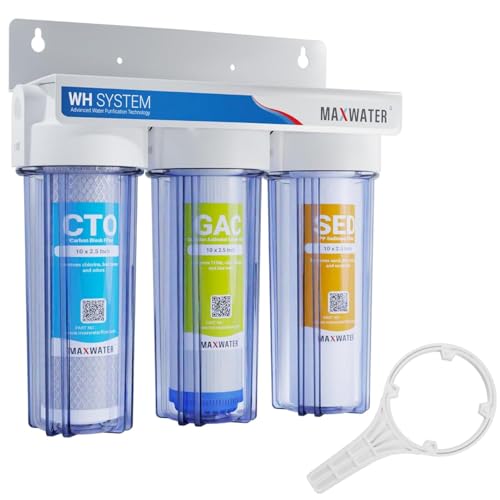
- 5-micron sediment plus GAC and CTO carbon stages
- Compact design with clear housings and gauges
- 1–10 GPM stated flow range
Best For: Compact city-water sediment and carbon filtration
Best with Extra Features
iSpring WHO32B 3-Stage Whole House Filter

- Horizontal housings simplify cartridge changes
- Up to 15 GPM and 100,000-gallon capacity
- Uses standard 20-by-4.5-inch replacement filters
Best For: High-capacity filtration with easier maintenance
Best UV Option
Geekpure 5-Stage Whole House Filter

- Adds a 6 GPM UV filtration stage
- Includes dual carbon and nano antiscale filtration
- Pressure gauges and release valve aid maintenance
Best For: Whole-home UV and carbon filtration
Best Heavy-Duty Ports
Dual Carbon 3-Stage Whole House Filter

- GAC and CTO carbon target chlorine and odors
- 1-inch NPT brass ports support durable connections
- Drain valves on all housings simplify maintenance
Best For: High-flow carbon filtration with sturdy fittings
Best Overall – PRO+AQUA Elite GEN2 PRO-100-E
For shoppers comparing multi stage whole house water filters, the PRO+AQUA Elite GEN2 stands out for its combination of sediment, heavy-metal, and carbon filtration. Its three stages are designed for city or well water, with pressure gauges that make filter monitoring easier.
Best For: Small to medium households with one to three bathrooms using city or well water.
Pros:
- Three-stage filtration targets sediment, dissolved metals, chlorine, VOCs, pesticides, odors, and tastes.
- Clear first-stage housing and stainless steel pressure gauges simplify system monitoring.
- Operates without electricity, regeneration, backwashing, or draining.
- Includes a five-year manufacturer warranty and lifetime U.S. technical support after activation.
Cons:
- Professional installation is specified, so setup may require a plumber.
- Filters are recommended for replacement every six months.
With a listed flow rate of up to 15 GPM and one-inch ports, this system is a practical fit when whole-home coverage and visible maintenance information matter more than a simple cartridge setup.
Best DIY Value – iSpring WGB32B Commercial-Grade
The iSpring WGB32B is a straightforward option for buyers seeking multi stage whole house water filters with a DIY-friendly design. Its three 20-by-4.5-inch cartridges combine sediment filtration with two coconut-shell carbon block stages.
Best For: Homeowners who want high-flow whole-house filtration and a manageable DIY installation.
Pros:
- Up to 15 GPM flow with one-inch NPT inlet and outlet connections.
- Five-micron sediment filtration and two CTO carbon block stages address chlorine, rust, tastes, odors, herbicides, and more.
- Listed 100,000-gallon capacity can provide about a year of filtration for a family of four.
- Individually wrapped cartridges help preserve freshness before installation.
Cons:
- It does not remove TDS, so it is not a substitute for reverse osmosis when dissolved-solids reduction is needed.
- The included manufacturer warranty is limited to one year.
This system balances substantial cartridge capacity with low-maintenance operation and keeps healthy minerals in the water, making it a sensible general-purpose choice for municipal water concerns.
Best Maintenance Features – WF3-01 3-Stage System
The WF3-01 adds useful service features to the multi stage whole house water filters category. Along with sediment, carbon, and compound GAC+KDF filtration, it includes pressure gauges, 180-day filter timers, relief and drain valves, and a housing-cleaning brush.
Best For: Buyers who prioritize clear maintenance reminders and flexible installation hardware.
Pros:
- Compound GAC+KDF filtration is designed to reduce lead, mercury, arsenic, cadmium, chromium, chlorine, and other chemicals.
- Pressure gauges help identify clogging, while built-in timers track a 180-day service period.
- Pre-installed relief and drain valves simplify cartridge servicing.
- Adapters support either three-quarter-inch or one-inch NPT connections.
Cons:
- The listed installation type is under-sink, so buyers should verify that the intended whole-house plumbing location is suitable.
- The product is physically large at approximately 31 inches high by 23 inches wide.
Its monitoring and cleaning accessories make routine upkeep more organized than with a basic housing-only system. The stated flow rate is up to 15 GPM, with a 100,000-gallon capacity.
Best for Iron and Manganese – iSpring WGB32BM
Among multi stage whole house water filters, the iSpring WGB32BM is the specialized pick for water containing iron and manganese. Its third-stage FM25B catalytic media is designed to reduce iron up to 3.0 ppm and manganese up to 1.0 ppm, while the other stages address sediment, chlorine, odors, and related contaminants.
Best For: Homes with well water concerns involving iron and manganese.
Pros:
- Dedicated third-stage media targets iron and manganese, with stated maximum reduction levels.
- Five-micron sediment filtration and coconut-shell carbon block filtration provide broader whole-house treatment.
- Up to 15 GPM flow and one-inch NPT connections are suited to main-line installation.
- Filters are rated for up to 100,000 gallons or one year, with DIY guidance available.
Cons:
- It does not reduce TDS, so dissolved-solids treatment requires a separate RO system.
- The one-year manufacturer warranty is shorter than some extended coverage options.
This is the most targeted choice in the group when iron and manganese are the primary issues. Verify your water concentrations against the product’s stated limits before choosing it.
Maximum Protection – Express Water Ultimate Protection 3-Stage
For shoppers comparing multi stage whole house water filters, the Express Water Ultimate Protection system stands out for its combination of sediment, chlorine, heavy-metal, and scale-focused treatment. Its freestanding stainless steel frame, pressure gauges, and pressure-release buttons make monitoring and filter changes more convenient.
Best For: Households wanting broad contaminant and anti-scale protection with a sturdy, monitored setup.
Pros:
- Designed to reduce chlorine and heavy metals including lead, arsenic, chromium, and mercury.
- Polyphosphate media helps address scale buildup in pipes and appliances.
- Supports up to 17 GPM and includes three pressure gauges plus release buttons.
- Heavy-duty stainless steel bracket and freestanding frame.
Cons:
- At 63 pounds and roughly 29 by 8.5 by 30 inches, it needs substantial installation space.
- Filters are listed with a six-month life cycle, depending on water conditions and use.
- It does not use a power source, so installation depends on suitable water pressure and plumbing.
This is a strong choice when protection from scale and heavy metals matters as much as improved chlorine and odor control. Its larger frame and monitoring hardware are most appropriate for buyers who have room for a more substantial whole-house system.
Long-Life Filtration – Waterdrop WHF3T-PG 3-Stage
The Waterdrop WHF3T-PG is a practical option among multi stage whole house water filters, combining sediment layers, KDF media, granular activated carbon, and carbon fiber. It is designed to reduce chlorine, odors, sediment, rust, and selected heavy metals while maintaining a stated 15 GPM flow rate.
Best For: Homes seeking a relatively long filter-replacement interval and broad filtration for municipal or well water.
Pros:
- Claims up to 98% chlorine reduction and helps reduce odors, sediment, rust, and heavy metals.
- 12-month filter life cycle may reduce replacement frequency compared with six-month systems.
- Supports a steady 15 GPM flow rate for household use.
- Materials are certified or tested against listed NSF, REACH, RoHS, and safety standards.
Cons:
- Operating temperature is limited to 40–100°F; the product should not be used below 40°F.
- The actual filter life depends on incoming water quality and usage.
- Its stated maximum supported TDS level is 1,000 ppm, so unusually challenging water may require additional treatment.
Waterdrop’s combination of multiple media types, a 15 GPM rating, and a listed 12-month filter cycle makes it appealing for buyers prioritizing maintenance convenience. Confirm the temperature, plumbing connections, and water conditions before installation.
City Water Value – Max Water 3-Stage 10-Inch System
The Max Water system is a compact choice among multi stage whole house water filters for city-water applications. Its 5-micron PP sediment stage is followed by GAC and CTO carbon filters to address particles, rust, chlorine, odors, cloudiness, and taste.
Best For: City-water households wanting a compact, DIY-friendly sediment and carbon filtration setup.
Pros:
- Uses 5-micron PP sediment filtration plus dual carbon filtration.
- Helps reduce dust, sand, rust, chlorine, odors, cloudiness, and unwanted taste.
- Clear housings allow visual inspection, while gauges and release buttons simplify maintenance.
- Compact 14.25-inch-long by 5.25-inch-wide footprint and a stated flow range of 1–10 GPM.
Cons:
- The stated maximum flow rate is 10 GPM, lower than the other systems in this comparison.
- Filters typically require replacement every 6–12 months, depending on water quality and usage.
- Its 3/4-inch NPTF ports need an adapter for garden-hose connections, and the adapter is not included.
This system fits buyers who mainly want practical sediment and carbon treatment without a large footprint. The clear housings and pressure hardware are useful for routine maintenance, but check the port requirements and household flow needs before buying.
Best with Extra Features – iSpring WHO32B 3-Stage Whole House Filter
The iSpring WHO32B is a practical choice among multi stage whole house water filters for households that want high flow, broad contaminant reduction, and easier cartridge changes. Its horizontal 20-by-4.5-inch housings use widely available replacement filters and support flow rates up to 15 GPM.
Best For: Homes seeking high-capacity filtration with simplified, low-lift filter replacement.
Pros:
- Horizontal slide-in housings and built-in drain valves make replacement easier.
- Reduces chlorine, sediment, rust, pesticides, VOCs, odors, and more.
- Supports up to 15 GPM and up to 100,000 gallons or 12 months of use.
- Uses standard, widely available 20-by-4.5-inch cartridges.
Cons:
- Does not remove total dissolved solids; an RO system is recommended for full TDS removal.
- Installation still requires compatible plumbing connections and setup.
Choose the WHO32B if convenience and capacity are priorities. Its freestanding metal frame and standard cartridges add flexibility, while the system retains healthy minerals rather than removing TDS.
Best UV Option – Geekpure 5-Stage Whole House Filter
The Geekpure system stands out among multi stage whole house water filters by combining sediment, dual-carbon, UV, and nano antiscale filtration. Installed at the main water supply, it is designed to treat water for the entire home while providing pressure gauges and a pressure-release valve for maintenance.
Best For: Homes wanting UV treatment alongside sediment, carbon, and odor filtration.
Pros:
- Five stages include PP sediment, two carbon filters, 6 GPM UV, and nano antiscale carbon filtration.
- UV treatment adds no chemicals and does not change taste, color, odor, pH, or conductivity.
- Pressure gauges help monitor filter status, while the release valve supports safer replacement.
- Filter life is rated at 6–12 months or up to 100,000 gallons, depending on conditions.
Cons:
- Requires electrical power for the UV stage.
- Does not reduce hardness, heavy metals, or TDS.
- Its stated UV flow rate is 6 GPM, even though maximum system flow can reach 15 GPM depending on pressure.
This is a strong fit when UV filtration is a priority. Confirm your water pressure, temperature, and electrical access before installation, and remember that the system retains minerals rather than softening water or removing TDS.
Best Heavy-Duty Ports – Dual Carbon 3-Stage Whole House Filter
This dual-carbon system is a straightforward option among multi stage whole house water filters, using sediment filtration followed by GAC and CTO carbon stages. It offers standard 20-by-4.5-inch cartridges, 1-inch brass ports, and drain valves on each housing for easier servicing.
Best For: Homes prioritizing chlorine and odor reduction, standard cartridges, and robust plumbing connections.
Pros:
- Three stages target dirt, sand, rust, chlorine, odors, VOCs, and lingering tastes.
- Each housing includes a bottom drain valve for depressurizing and reducing spills during changes.
- 1-inch NPT brass inlet and outlet ports support durable, secure connections.
- Includes three cartridges, a steel bracket, wrench, mounting screws, and Teflon tape.
Cons:
- Provides carbon and sediment filtration but does not include UV treatment.
- Wall mounting and plumbing connections require installation space and setup.
Consider this model if you want a high-flow, carbon-focused system with service-friendly drains and sturdy brass ports. Its 15 GPM maximum flow and up-to-100,000-gallon capacity suit many whole-home applications.
How We Picked the Best Multi Stage Whole House Water Filters
We focused on systems designed to treat water at the main supply line, including three-stage models and higher-stage configurations. Our comparison considered the type of media used, stated contaminant-reduction goals, housing size, connection size, pressure-gauge availability, replacement-filter access, and suitability for city or well water.
Because water quality varies by location, product claims should be matched with an independent water test and the manufacturer’s performance documentation. A filter that targets chlorine may not address iron, arsenic, bacteria, hardness, or other well-water concerns.
Quick Comparison
- Best for broad city-water filtration: Look for sediment and carbon stages that target particles, chlorine, tastes, and odors.
- Best for well water: Consider systems specifically designed for iron, manganese, or heavy metals, but verify capacity and pretreatment requirements.
- Best for monitoring pressure: Choose a setup with pressure gauges or an easy way to check pressure loss as filters load.
- Best for easier maintenance: Horizontal or accessible housings can simplify cartridge replacement in tight utility spaces.
- Best for higher flow: Commercial-grade housings and larger ports may be preferable for homes with several simultaneous water users.
Key Buying Factors for Multi-Stage Whole-House Water Filters
Filter Stages and Media
More stages do not automatically mean better filtration. Sediment cartridges protect downstream media, carbon reduces chlorine and many odors, and specialized media may target iron, manganese, or selected metals. Confirm the exact contaminants each cartridge is rated to reduce.
Flow Rate and Pressure
Compare the system’s rated flow with your household demand. Undersized housings can restrict pressure, especially when multiple showers, appliances, or faucets run at once. Pressure gauges are useful for identifying when clogged filters need attention.
Water Source and Testing
City water and well water create different priorities. Municipal supplies commonly call for sediment and chlorine reduction, while wells may require testing for iron, manganese, hardness, sulfur, metals, and microbiological issues. A whole-house filter is not a substitute for disinfection or water softening when those treatments are necessary.
Installation and Replacement Cost
Check port size, available clearance, shutoff-valve requirements, included mounting hardware, and whether replacement cartridges are easy to source. Budget for recurring filter costs, not just the initial system price.
Who Should Buy Which Multi Stage Whole House Water Filters?
Choose a general three-stage carbon-and-sediment system if your main concerns are chlorine, sediment, taste, and odor in treated city water. Select an iron- or manganese-focused model when testing confirms those issues in well water. A heavy-metal-focused system may suit homes with verified lead or other metal concerns, provided its certifications and cartridge specifications match the contaminant and concentration.
For larger households or homes with high peak flow, prioritize commercial-grade housings, larger connections, and documented flow performance. If installation space is limited, look for a compact or horizontally oriented design. Whichever system you choose, install it with the correct bypass and shutoff arrangement, test the water periodically, and replace cartridges according to pressure drop, capacity, or the manufacturer’s schedule.