When storms, outages, or weak cell service disrupt your normal sources of information, a dependable emergency radio can provide weather alerts, lighting, and backup power in one compact device.
We selected 10 emergency radios with crank across a range of battery capacities, charging options, alert features, and portability needs so you can choose the right fit for your emergency kit.
Best 10 Emergency Radios with Crank Picks for 2026
Best Overall
Midland ER310 Emergency Crank Radio

- AM/FM radio with NOAA weather scan and alerts
- Solar power plus six included AA batteries
- Flashlight and ultrasonic dog whistle included
Best For: Home emergency kits and outdoor preparedness
Best Lighting Package
RunningSnail Emergency Crank Radio

- 4000mAh battery with solar, crank, and USB charging
- Three-mode flashlight and motion-sensor reading lamp
- NOAA, AM, and FM reception in a water-resistant design
Best For: Families, outages, and camping
Best Compact Option
FosPower A1 Solar Hand Crank Radio

- 2000mAh power bank for phones and small tablets
- AM/FM/weather-band reception with NOAA broadcasts
- Flashlight, reading light, SOS alarm, and water resistance
Best For: Compact emergency kits and outdoor carry
Best High-Capacity Battery
Aivica 20000mAh Hand Crank Radio

- 20000mAh battery with solar, crank, and Type-C charging
- 3W spotlight, 96-LED reading lamp, and 120dB SOS alarm
- IPX4 water resistance and four-foot drop-survival claim
Best For: Extended outages, camping, and high-power emergency use
Most Versatile
Kaito KA500 Multi-Band Emergency Radio

- Multiple charging and power options
- AM/FM, shortwave, and NOAA coverage
- Includes lighting and USB device charging
Best For: Households and outdoor users wanting broad coverage and flexible backup power
Best Battery Capacity
10000mAh Hand Crank Emergency Radio

- Large 10000mAh internal battery
- Solar, hand-crank, and USB-C charging
- IPX6 splash-resistant design with compass
Best For: Preparedness users who prioritize phone backup power and outdoor portability
Best Lightweight Pick
Esky Compact Hand Crank Weather Radio

- Compact 7.55-ounce design with lanyard
- Three charging methods and 2000mAh battery
- 140-lumen flashlight plus SOS alarm
Best For: Portable kits, camping, vehicles, and lightweight emergency carry
Most Powerful Battery

- 12000mAh battery with USB device charging
- NOAA, AM/FM, solar, hand-crank, and USB-C power
- 5W flashlight, reading lamp, SOS alarm, and IPX6 resistance
Best For: Home kits, hurricanes, RVs, and extended backup use
Best Alert Features

- Automatic NOAA alert scanning, including standby mode
- Six charging options with hand crank and solar power
- LCD display, headphone jack, lights, and USB charging
Best For: Automatic warning monitoring and flexible power backup
Best Simple Pick
iRonsnow 2000mAh Hand-Crank Radio
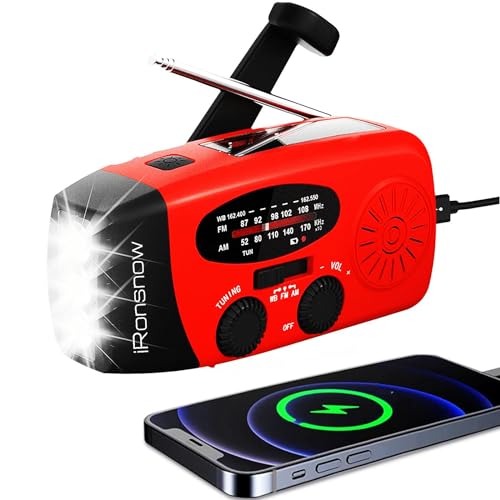
- Lightweight 7.84-ounce compact design
- NOAA/AM/FM, solar, hand-crank, and USB-C charging
- Battery indicator, flashlight, SOS mode, and phone charging
Best For: Go bags, car kits, camping, and lightweight carry
Best Overall – Midland ER310 Emergency Crank Radio
For shoppers comparing emergency radios with crank capability, the Midland ER310 is a straightforward preparedness option with AM/FM reception, NOAA weather scanning and alerts, and multiple power sources. Its built-in flashlight and ultrasonic dog whistle add useful emergency functions without making the radio overly complicated.
Best For: Home emergency kits and outdoor users who want weather alerts plus basic lighting and signaling tools.
Pros:
- Supports multiple power sources, including solar power and six included AA batteries.
- NOAA weather scan and alert function helps monitor severe-weather information.
- Includes a built-in flashlight and ultrasonic dog whistle.
Cons:
- Not water resistant, according to the listed specifications.
- Uses a 2-band AM/FM tuner rather than a listed NOAA-band tuner.
The ER310 focuses on dependable preparedness basics and includes a one-year limited warranty. It is a practical pick for buyers who prioritize weather scanning, flexible power, and emergency signaling over advanced charging features.
Best Lighting Package – RunningSnail Emergency Crank Radio
The RunningSnail is one of the more feature-rich emergency radios with crank charging, pairing NOAA, AM, and FM reception with a 4000mAh built-in battery. Its three-mode flashlight, motion-sensor reading lamp, USB charging support, and water-resistant build make it useful during outages and outdoor activities.
Best For: Families and campers who want a rechargeable radio with versatile lighting and phone-charging capability.
Pros:
- Offers four power options: Micro USB, solar, hand crank, and built-in battery power.
- 4000mAh battery can charge smartphones in an emergency.
- Combines a three-mode flashlight with a motion-sensor reading lamp.
- Water-resistant ABS construction supports outdoor and emergency use.
Cons:
- The supplied notes do not specify an IP water-resistance rating.
- Its one-watt speaker output may be less suitable for filling larger spaces.
With a broad set of power and lighting options, this RunningSnail model is designed for practical versatility. It is especially compelling when a radio must also serve as a bedside light, camping lamp, and backup phone charger.
Best Compact Option – FosPower A1 Solar Hand Crank Radio
The FosPower A1 is a compact choice among emergency radios with crank charging, offering AM/FM/weather-band reception, a 2000mAh power bank, and three listed power sources. Its separate reading light and one-watt flashlight provide useful illumination for outages, travel, and outdoor emergencies.
Best For: Buyers who want a small, water-resistant emergency radio with phone charging and multiple lighting modes.
Pros:
- Includes a 7400mWh/2000mAh power bank for small tablets or phones.
- Supports hand-crank, solar, and AAA-battery power.
- Provides NOAA weather broadcasts along with AM/FM reception.
- Offers a one-watt flashlight and four-LED reading light.
Cons:
- Requires four AAA batteries, which are not listed as included.
- The listed power bank is smaller than the capacity offered by some larger models.
At about 6.2 inches long and 310 grams, the A1 is easy to store in an emergency kit or carry outdoors. Its limited lifetime warranty is another advantage for buyers seeking long-term support from a compact preparedness device.
Best High-Capacity Battery – Aivica 20000mAh Hand Crank Radio
For shoppers seeking emergency radios with crank charging and substantial backup power, the Aivica XSY350 stands out with a listed 20000mAh battery. It combines AM/FM/weather reception, a spotlight, reading lamp, SOS alarm, solar and Type-C charging, and phone-charging support in a compact emergency device.
Best For: Extended outages, camping, and emergency kits where battery capacity and lighting are top priorities.
Pros:
- Large 20000mAh battery is listed to power the radio for 48-plus hours and charge an iPhone 14 Pro multiple times.
- Offers solar, hand-crank, and Type-C charging options.
- Combines a 3W spotlight, 96-LED reading lamp, and 120dB SOS alarm.
- IPX4-rated water resistance and a stated four-foot drop-survival claim support outdoor use.
Cons:
- The supplied details identify the tuner as AM, while the product description also references AM/FM/weather reception; buyers should verify band specifications.
- Its one-year warranty is shorter than the limited lifetime warranty listed for the FosPower model.
The Aivica is built around endurance, with a high-capacity battery, energy monitoring, and several emergency signaling tools. Its feature set is best suited to users who want a backup charging station and strong illumination in addition to a weather radio.
Most Versatile – Kaito KA500 Multi-Band Emergency Radio
The Kaito KA500 is a versatile choice for shoppers comparing emergency radios with crank. It combines hand-crank, solar, battery, and USB-powered operation with AM/FM, shortwave, and NOAA weather coverage, plus lighting and device-charging features.
Best For: Households and outdoor users who want broad radio-band coverage and multiple backup-power options.
Pros:
- Supports hand-crank, solar, three AA batteries, USB, and an internal rechargeable battery pack.
- Receives AM, FM, two shortwave bands, and seven pre-programmed NOAA weather channels.
- Includes a flashlight, five-LED reading lamp, SOS beacon, and USB output for charging devices.
- Uses an extended telescopic antenna, signal-strength indicator, and water-resistant ABS construction.
Cons:
- Three AA batteries are required but not included.
- Wall power adapter is sold separately.
- NOAA weather coverage is specified for the USA and Canada.
Choose the KA500 if flexibility matters most. Its wider band selection and numerous power and lighting features make it a strong all-purpose emergency radio, though its extra functions may be more than needed for a basic go-bag setup.
Best Battery Capacity – 10000mAh Hand Crank Emergency Radio
This 10000mAh model stands out among emergency radios with crank for its large internal battery and compact, splash-resistant design. It adds solar and USB-C charging, manual AM/FM and NOAA reception, a compass, and multiple lighting modes for emergency kits and outdoor use.
Best For: Users prioritizing extended backup battery capacity for phones, lighting, and radio listening.
Pros:
- Built-in 10000mAh battery provides backup power, with approximately 1–1.5 iPhone 14 charges under the stated conditions.
- Can be charged by hand crank, solar panel, or USB-C input.
- Includes AM/FM and NOAA reception, a three-mode flashlight, reading lamp, and compass.
- IPX6 water resistance helps protect against water spray and splashing.
Cons:
- NOAA reception requires manual tuning and does not provide SAME or automatic alerts.
- IPX6 protection is for splashing and spray, not immersion or heavy rain.
- Hand-crank charging and phone output vary with cranking speed and conversion efficiency.
The large battery makes this a compelling option when phone charging is a priority. Buyers who want automatic weather alerts or waterproofing for severe exposure should look elsewhere, but its power capacity and practical outdoor features are well suited to preparedness storage.
Best Lightweight Pick – Esky Compact Hand Crank Weather Radio
The Esky ES-CR01 is a compact, lightweight option for shoppers seeking emergency radios with crank for a pocket, vehicle, or camping kit. It provides AM/FM/NOAA reception, three charging methods, a 2000mAh battery, bright lighting, and an SOS alarm in a small format.
Best For: Portable emergency kits, camping, trunks, and users who want a simple lightweight radio with built-in lighting.
Pros:
- Uses USB, solar, or hand-crank charging and includes a 2000mAh rechargeable battery.
- Provides approximately nine hours of radio use or 20 hours of flashlight use when fully charged.
- Combines AM/FM/NOAA reception with a 140-lumen, three-LED flashlight and SOS alarm.
- Compact 5-inch design weighs about 7.55 ounces and includes a lanyard.
Cons:
- The 2000mAh battery offers less capacity than larger emergency-radio models.
- Regular charging is recommended to avoid depletion during storage.
- The supplied notes do not specify automatic NOAA alert functionality.
The Esky is a practical choice when portability matters more than maximum battery capacity. Its small size and useful light make it easy to keep close at hand, while the crank, solar, and USB options provide basic power flexibility for short-term emergencies.
Most Powerful Battery – 12000mAh NOAA Emergency Radio
For shoppers comparing emergency radios with crank, this OnLyee model stands out for its large 12000mAh battery and several backup charging methods. It combines NOAA, AM, and FM reception with lighting, an SOS alarm, and phone charging for blackouts, severe weather, camping, or RV use.
Best For: Home emergency kits, hurricane preparedness, RV travel, and users who want extended battery capacity.
Pros:
- Large 12000mAh rechargeable battery can power the radio, lights, SOS function, and emergency USB charging.
- Supports NOAA weather broadcasts, AM/FM reception, solar charging, hand-crank charging, and USB-C input.
- Includes a 5W flashlight, 12-LED reading lamp, 120dB SOS alarm, and IPX6 water-resistant design.
Cons:
- At 1.6 pounds, it is heavier than compact emergency-radio options.
- The NOAA broadcasts must be selected and tuned while the radio is powered on.
This is a feature-rich choice when battery capacity, lighting, and weather monitoring matter more than minimum size. Its solar panel and hand crank provide useful alternatives when conventional charging is unavailable.
Best Alert Features – Raynic Weather Alert Radio
This Raynic model is a strong contender among emergency radios with crank because it can automatically scan for emergency and weather alerts, including while in standby mode. Its digital tuning, LCD display, multiple charging options, and headphone jack make it practical for both home preparedness and outdoor trips.
Best For: Users who prioritize automatic NOAA alerts, easy digital tuning, and private listening.
Pros:
- Automatic NOAA weather-alert scanning can notify you of warnings without continuous listening.
- Offers six power options: rechargeable battery, AC adapter, USB input, hand crank, solar panel, and three AAA batteries.
- Features a large LCD, AM/FM/SW/NOAA reception, 3W flashlight, reading lamp, USB charging, and headphone jack.
Cons:
- Its IPX3 water resistance is more limited than higher-rated outdoor designs.
- Three AAA batteries are not included.
The standout feature is automatic alert monitoring, which can be especially useful overnight. It is a versatile, relatively portable option, though its lower water-resistance rating favors sheltered use or careful outdoor handling.
Best Simple Pick – iRonsnow 2000mAh Hand-Crank Radio
If portability is a priority, this iRonsnow is a compact choice among emergency radios with crank. It provides NOAA, AM, and FM reception, USB-C charging, solar and hand-crank power, a battery-level indicator, a flashlight, and an SOS mode in a lightweight 7.84-ounce design.
Best For: Go bags, hiking, camping, car kits, and shoppers seeking a lightweight backup radio.
Pros:
- Compact 5-by-1.8-by-2.4-inch design weighs just 7.84 ounces.
- Supports USB-C, solar, and hand-crank recharging, with a four-level battery indicator.
- Includes NOAA/AM/FM reception, a 1W flashlight with three brightness levels, SOS alarm mode, and a 2000mAh phone-charging battery.
Cons:
- Its 2000mAh battery is substantially smaller than the capacity offered by larger models.
- The product notes indicate that versions may ship randomly, including different light configurations.
- It is water resistant rather than described as fully waterproof.
This model makes sense when space and weight are more important than maximum runtime. It covers the core emergency functions and is easy to keep in a backpack, vehicle, or compact preparedness kit.
How We Picked the Best Emergency Radios with Crank
We focused on practical emergency performance rather than appearance alone. Each model was evaluated for its charging methods, NOAA weather access, battery capacity, lighting, radio-band coverage, phone-charging capability, and ease of use during an outage. We also considered portability and whether the feature set makes sense for the intended use, from a compact go-bag to a home emergency kit.
Crank radios are most useful when they combine several independent power sources. Solar charging can help during extended outages, while hand cranking provides immediate backup when the battery is empty or sunlight is unavailable.
Quick Comparison
| Best For | Look For |
|---|---|
| Basic storm preparedness | AM/FM, NOAA alerts, flashlight, and a simple crank |
| Extended outages | Higher-capacity battery, solar charging, and USB output |
| Portable emergency kits | Compact size, durable housing, and low weight |
| Broad broadcast coverage | AM/FM, NOAA, and shortwave-band support |
| Nighttime emergencies | Bright flashlight, reading lamp, or multiple lighting modes |
Key Buying Factors for Emergency Radios with Crank
Charging and Battery Capacity
Battery ratings vary widely, and a larger capacity generally provides more runtime for lights or USB charging. Still, capacity is not the only consideration: confirm whether the radio supports hand crank, solar, USB, or replaceable-battery charging. A crank is best treated as an emergency reserve because generating significant power manually takes time and effort.
Weather Alerts and Reception
NOAA weather-band reception is a core feature for many buyers in the United States, but reception quality depends on location and antenna design. An alert function can be especially helpful when you cannot monitor the radio continuously. AM/FM coverage is useful for local updates, while shortwave support may broaden access to distant broadcasts.
Lighting and Phone Charging
A built-in flashlight can replace a separate light in a basic kit, while a reading lamp is more useful for maps, instructions, or bedside use. USB phone charging is convenient, but it can drain the radio quickly and may provide only limited emergency power. Keep a dedicated power bank when reliable phone charging is essential.
Size, Controls, and Durability
Choose controls that are easy to identify in darkness and a body that can tolerate storage in a vehicle, basement, or go-bag. Check the radio’s weight, handle design, antenna, water resistance claims, and whether the display remains readable in low light.
Who Should Buy Which Emergency Radios with Crank?
Choose a compact, straightforward model if you want a lightweight radio for hiking, evacuation, or a small emergency kit. For households preparing for multi-day outages, prioritize a larger battery, solar input, USB output, and multiple lighting options. Buyers who want broader listening choices should consider a model with shortwave alongside AM/FM and NOAA bands.
If severe weather is your main concern, make NOAA alerts and dependable reception the priority. For occasional backup use, a simpler radio with a flashlight and hand crank may offer better value than paying for features you are unlikely to use. Whatever you choose, test it periodically, recharge its battery, and store it where every household member can find it.