When a disaster disrupts tap water, a reliable filter can turn questionable water sources into a more practical emergency backup. The right choice depends on how many people you need to support, how quickly you need clean water, and how much equipment you can store.
We compare 10 water filters for emergencies, from lightweight personal straws to higher-capacity gravity systems, so you can choose a setup that fits your household, vehicle, bug-out bag, or camping kit.
Best 10 Water Filters for Emergencies Picks for 2026
Best Ultralight Pick

- 2-ounce 0.1-micron hollow-fiber filter
- Works with pouches, bottles, and hydration packs
- Rated up to 100,000 gallons
Best For: Solo travel, hiking, and compact emergency kits
Best Two-Pack Value
Practical Survival Filter Straws

- Two individually sealed 0.1-micron filter straws
- Includes a backflushing plunger per filter
- Lightweight option for disaster and travel kits
Best For: Shared emergency kits, vehicles, and direct drinking
Best Flexible Squeeze System

- Two 32-ounce collapsible pouches included
- Works with bottles, hydration packs, and gravity setups
- Rated up to 100,000 gallons
Best For: Backpacking and adaptable emergency water collection
Best for Groups
Membrane Solutions 6L Gravity Filter
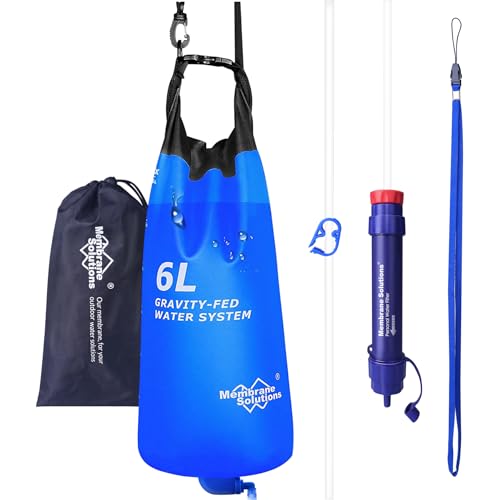
- 6-liter system designed for 3–6 people
- Pump-free gravity operation with no electricity
- Four-stage filtration and up to 1,320-gallon life
Best For: Family camping, basecamps, and household emergency backup
High-Capacity Pick
6-Piece Gravity Filtration Kit

- Two 6-liter bags support group hydration
- 1,800-gallon filter capacity
- Includes cleaning plunger and carry bag
Best For: Families, groups, and emergency preparedness
Compact Survival Option
Waterdrop Gravity Filter Straw
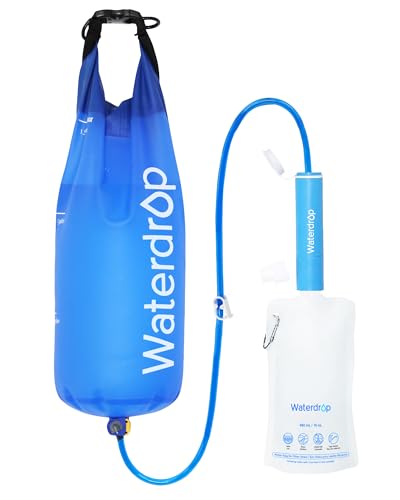
- Lightweight 4.64-ounce design
- 1,400-gallon stated filter life
- Includes 1.5-gallon bag and water pouch
Best For: Personal emergency kits and outdoor use
Best for Comfort
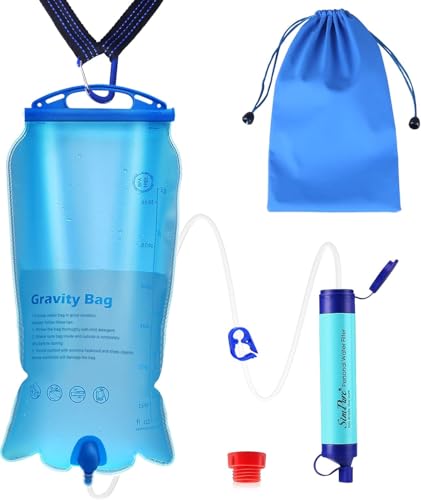
- Approximately 3.2 ounces
- 27 liters-per-hour flow rate
- Rollable 3-liter bag with tree strap
Best For: Ultralight backpacking and compact emergency storage
Compact Straw Protection
Timain 4-Stage Water Filter Straws

- Four-stage filtration with a 0.1-micron membrane and activated carbon
- Two lightweight straws with bottle, bladder, and direct-use options
- Rated for up to 1,000 gallons with proper use and maintenance
Best For: Portable emergency kits, hiking, camping, and backup hydration
Household Gravity Reserve
Emergency Gravity-Fed Water Filter System

- No electricity, batteries, or pump required
- Filters up to 24 gallons per day
- Includes containers, spigot, filters, and connection hardware
Best For: Families, shelters, off-grid use, and stationary emergency water storage
Family Pack Portability
Yuclet 4-Pack Emergency Water Filter Straws

- Four personal filters for family or group emergency kits
- 0.1-micron hollow-fiber filtration with activated carbon
- Up to 1,300 gallons per unit and 600ml/min maximum flow
Best For: Families, shared go-bags, camping groups, and personal backup hydration
Best Ultralight Pick – Sawyer MINI Water Filter
For hikers, travelers, and emergency kits, the Sawyer MINI is one of the most compact water filters for emergencies. Its 2-ounce hollow-fiber filter can connect to the included pouch, compatible 28 mm bottles, or a hydration pack, while its long rated capacity reduces the need for frequent replacement.
Best For: Solo outdoor use, travel, and compact emergency-preparedness kits.
Pros:
- Very light and compact at approximately 2 ounces.
- Removes listed bacteria, protozoa, and microplastics through a 0.1-micron absolute filter.
- Includes a reusable pouch, drinking straw, and cleaning plunger.
- Rated for up to 100,000 gallons by the manufacturer.
Cons:
- The included pouch holds only 16 ounces.
- Manual squeezing or direct drinking is required; it is not an electric system.
- It is better suited to individual use than preparing large quantities for groups.
The MINI stands out when pack weight and versatility matter most. Its pouch, bottle, straw, and hydration-pack compatibility make it a flexible choice for personal emergency water needs.
Best Two-Pack Value – Practical Survival Filter Straws
This two-pack gives emergency planners a simple way to distribute water filters for emergencies between a go-bag, vehicle, or household kit. Each 8-inch straw weighs about 2 ounces and uses hollow-fiber filtration rated to 0.1 micron, with an individual backflushing plunger included.
Best For: Couples, backup kits, and people who want two individually sealed drinking straws.
Pros:
- Includes two lightweight, portable filter straws.
- Designed to reduce listed bacteria, parasites, and microplastics.
- Each filter includes its own backflushing plunger.
- Useful for camping, disasters, power outages, and vehicle storage.
Cons:
- Each straw has a lower stated capacity than the Sawyer systems in this roundup.
- The straw format is primarily for direct drinking rather than filling larger containers.
- Supplied specifications list differing capacity figures, so buyers should confirm the current product details.
The main advantage is redundancy: two individually packaged filters provide a practical backup for shared preparedness. Choose this set when direct drinking and portability are more important than higher-volume water collection.
Best Flexible Squeeze System – Sawyer Squeeze Filter
The Sawyer Squeeze is a versatile option for water filters for emergencies because it can filter from collapsible pouches, compatible 28 mm bottles, or a gravity setup. Its two 32-ounce pouches also make it more practical than a small direct-drinking straw when you need to collect and carry water.
Best For: Backpackers and emergency users who want multiple filling and drinking options.
Pros:
- Includes two reusable 32-ounce collapsible pouches.
- Supports direct drinking, bottle connection, hydration-pack use, and gravity filtration.
- Its 0.1-micron filter is listed to remove harmful bacteria, protozoa, cysts, sediment, and microplastics.
- Rated for up to 100,000 gallons and backed by a manufacturer lifetime defect warranty.
Cons:
- Squeezing is manual unless configured as a gravity system.
- The pouches require careful handling because collapsible containers can be less rigid than bottles.
- It is more involved to pack and configure than a single drinking straw.
This is the strongest all-around choice for users who want one filter to adapt to several water-storage and drinking methods. The dual pouches are especially useful when collecting more than a single serving at a time.
Best for Groups – Membrane Solutions 6L Gravity Filter
For families or basecamps, this 6-liter gravity system is a practical choice among water filters for emergencies. It is designed for three to six people and operates without squeezing, pumping, or electricity, while its four-stage design combines a hollow-fiber membrane, activated carbon, and dual PP pre-filters.
Best For: Group camping, family emergency supplies, and off-grid water backup.
Pros:
- 6-liter capacity is suited to group use.
- Gravity-fed operation requires no pump, power, or manual squeezing.
- Four-stage filtration is listed to reduce chlorine, sediment, and odor.
- NSF/ANSI 42, 372, and 401 standards are listed, with a stated life of up to 1,320 gallons.
Cons:
- At 12.8 ounces, it is heavier than the personal straw-style options.
- It needs a suitable place to hang for gravity operation.
- Its stated flow rate is up to 0.5 liter per minute, so filling multiple containers takes time.
This system makes the most sense when several people need filtered water and convenience matters more than minimum pack weight. Its larger reservoir and pump-free design suit a home emergency kit, campsite, or bug-out setup.
High-Capacity Pick – 6-Piece Gravity Filtration Kit
For households or groups preparing for emergencies, this gravity system is one of the more substantial water filters for emergencies. Its two 6-liter bags, 1,800-gallon filter life, and no-pump setup make it practical for basecamp use or extended outages.
Best For: Families, groups, and emergency kits that need a higher-capacity gravity setup.
Pros:
- Filters bacteria, parasites, and microplastics down to 0.1 micron, according to the supplied specifications.
- Two oversized bags provide a combined 12-liter holding capacity.
- Includes a cleaning plunger, connectors, and carry bag.
- Compatible with standard soda or water bottle threads.
Cons:
- At approximately 1.5 pounds, it is heavier than the compact straw-style options.
- The 0.6 gpm maximum flow rate may be slower than some higher-flow systems.
This is the strongest choice here when capacity and group use matter more than minimizing pack weight. The hanging-bag design also keeps operation simple during emergencies.
Compact Survival Option – Waterdrop Gravity Filter Straw
The Waterdrop Gravity Filter Straw is a compact option for water filters for emergencies, camping, and first-aid supplies. It combines a 1.5-gallon gravity bag with a 0.1-micron ultrafiltration membrane and can also connect to compatible bottles.
Best For: Individuals who want a lightweight emergency filter with a moderate-capacity water bag.
Pros:
- Weighs approximately 4.64 ounces.
- Provides a stated filter life of up to 1,400 gallons.
- Offers a maximum flow rate of up to 700 milliliters per minute.
- Backwashable design helps maintain the filter when flow decreases.
Cons:
- The included bag holds 1.5 gallons, less than the larger systems in this roundup.
- The listed limited filter warranty lasts 30 days.
Its low weight and bottle-and-bag compatibility make it easy to keep in a go-bag. The smaller reservoir is best suited to personal use rather than serving a large group.
Best for Comfort – SimPure 3L Gravity Filter
For packability, the SimPure portable gravity-fed filter is a practical contender among water filters for emergencies. It weighs about 3.2 ounces, rolls up for storage, and uses a 3-liter bag with a tree strap for hands-free filtration.
Best For: Backpackers and emergency planners prioritizing minimal weight and flexible use.
Pros:
- Very lightweight and rollable for compact storage.
- Filters at up to 27 liters per hour.
- Uses a 0.1-micron hollow-fiber membrane plus carbon and PP filtration.
- Can be used with a bottle, extension tube, or as a personal filter.
Cons:
- The 3-liter bag has less capacity than the larger gravity systems.
- The listed filter life is 1,320 gallons, lower than the first product’s stated capacity.
This model stands out when every ounce matters. Its flexible connection options and fast stated treatment rate add convenience, while the smaller bag keeps it better suited to individuals or small groups.
Compact Straw Protection – Timain 4-Stage Water Filter Straws
For lightweight water filters for emergencies, the Timain two-pack offers a portable option for treating fresh surface water. Its four-stage design combines an ultrafiltration membrane, mesh, and activated carbon, while the included hoses support several setup options.
Best For: Individuals building compact emergency kits, hiking packs, or travel and camping gear.
Pros:
- Four-stage filtration uses a 0.1-micron ultrafiltration membrane and activated carbon.
- Can be used directly, attached to compatible 28mm bottles or water bags, or connected to a hydration bladder.
- Compact 3-ounce design and rated capacity of up to 1,000 gallons with proper maintenance.
- Includes two straws, two silicone hoses, and carrying-oriented paracord.
Cons:
- Manual suction or squeezing is required; it is not an automatic system.
- Designed for fresh surface water, so source selection and proper use remain important.
This Timain pack makes the most sense when portability and a two-person or backup setup matter more than high-volume household filtration. Its flexible connections add utility for emergency and outdoor use.
Household Gravity Reserve – Emergency Gravity-Fed Water Filter System
For households comparing water filters for emergencies, this gravity-fed system is built for larger daily output than a personal straw. It needs no electricity, pumps, or batteries, and its bucket-style design can process up to 24 gallons per day.
Best For: Families, shelters, off-grid locations, and preparedness setups that need a countertop water supply.
Pros:
- Gravity-powered operation works without electricity, batteries, or a pump.
- Rated to filter up to 24 gallons per day for household or group use.
- Compatible with collected water from lakes, rivers, streams, and stored rainwater according to the supplied notes.
- Includes filters, spigot, containers, connectors, gaskets, and a manual.
Cons:
- At 6 pounds and 12 by 12 by 24 inches, it is less packable than personal filters.
- Its gravity-fed process requires filling the upper chamber and waiting for filtration.
- The system is intended for countertop or stationary use rather than direct drinking on the move.
The Outback Ready System is the stronger fit when emergency water needs extend beyond one person. Its larger footprint is a tradeoff for substantially higher stated daily capacity and no-power operation.
Family Pack Portability – Yuclet 4-Pack Emergency Water Filter Straws
The Yuclet four-pack is a practical choice for water filters for emergencies when several people need individual backup units. Each straw weighs 3.5 ounces, supports direct drinking or bottle connections, and is rated for up to 1,300 gallons with proper use and maintenance.
Best For: Families, shared emergency kits, and groups that want separate personal filters for outdoor or backup hydration.
Pros:
- Four individual filters provide a ready-to-distribute family or group setup.
- 0.1-micron hollow-fiber filtration with activated carbon is designed to address microplastics and unwanted tastes.
- Works directly with fresh water sources, gravity systems, and standard 28mm and 30mm bottles.
- Offers a stated maximum flow rate of 600ml per minute and up to 1,300 gallons per unit with maintenance.
Cons:
- Each unit requires manual suction and does not provide a shared household reservoir.
- Individual straw filtration is less suited to producing large volumes for cooking or group containers.
- The supplied notes specify use with freshwater sources, not every possible emergency water contaminant.
Yuclet’s main advantage is quantity: four compact filters make it easier to equip multiple people without adding much pack weight. Choose it for distributed personal use rather than centralized, high-volume filtration.
How We Picked These Water Filters for Emergencies
We focused on portable filtration systems designed for emergency preparedness, camping, hiking, and temporary disruptions. The selection includes personal drinking straws, squeeze filters, gravity-fed systems, and multi-pack options. We considered portability, stated filtration performance, capacity, flow design, included accessories, ease of use, and suitability for individual or group needs.
Because product specifications and certifications can vary, verify the manufacturer’s current claims before relying on any filter for critical preparedness. Filtration is not the same as disinfection, and many portable filters do not remove viruses, chemicals, fuel, salt, or every dissolved contaminant.
Quick Comparison
| Filter Type | Best For | Main Advantage | Typical Limitation |
|---|---|---|---|
| Personal straw | Individuals and emergency kits | Small, lightweight, simple to pack | Usually filters as you drink and may not fill containers easily |
| Squeeze system | Solo users and small groups | Flexible water collection and drinking options | Requires manual squeezing and careful backflushing |
| Gravity system | Families, camps, and base camps | Hands-off filtration and larger output | Bulkier and dependent on hanging or elevated setup |
| Multi-pack | Households and shared emergency supplies | Provides several individual units | May offer less capacity per unit |
Key Buying Factors for Water Filters for Emergencies
Capacity and Speed
Estimate daily demand before choosing a filter. A straw can work well for one person on the move, while a gravity-fed model is usually more practical for several people who need water for drinking and cooking. Check the claimed flow rate and total gallon capacity, but remember that real-world speed can decline as the filter loads with sediment.
What the Filter Removes
Look for clearly stated pore size and contaminant-reduction claims. Many portable filters target bacteria, protozoa, and sediment, but they may not address viruses or chemical pollution. If your emergency water could contain sewage, industrial runoff, or unknown chemicals, pair filtration with an appropriate disinfection method and use safer water sources whenever possible.
Storage and Maintenance
Choose equipment you can store dry, inspect, and operate without electricity. Replacement cartridges, cleaning instructions, backflushing tools, collection bags, and adapters all affect long-term usefulness. Keep a backup method for treating water if the primary filter becomes clogged or damaged.
Portability and Durability
For vehicles and evacuation bags, prioritize compact construction and low weight. Home or group preparedness can justify a larger reservoir and higher capacity. Also consider whether the included pouches, hoses, and connectors are sturdy enough for repeated use.
Who Should Buy Which Water Filters for Emergencies?
- For a personal go-bag: Choose a compact straw or lightweight squeeze filter that can be used directly from a bottle, pouch, or natural water source.
- For couples or small households: A squeeze system offers a useful balance of portability, versatility, and the ability to produce water into a container.
- For families and group camping: A gravity-fed filter is generally more convenient because it can process larger quantities without constant pumping or squeezing.
- For shared emergency kits: A multi-pack can give each person an individual backup, while a larger gravity system can serve as the household’s main unit.
- For uncertain water conditions: Select a filter with claims that match the likely contaminants, and supplement it with boiling or certified disinfection when appropriate.