The best ratcheting cable cutters make large copper, aluminum, and multi-core cables easier to cut cleanly without relying on excessive hand force. Their geared mechanisms and hardened blades can improve control, reduce hand fatigue, and help prevent crushed cable ends.
This roundup compares 10 options ranging from compact professional tools to heavy-duty cutters rated for large conductors. Use the buying guide below to match cutting capacity, materials, ergonomics, and durability to your typical work.
Best 10 Ratcheting Cable Cutters Picks for 2026
Best Overall Capacity
Southwire Ratcheting Cable Cutter

- Cuts copper and aluminum cable up to 750 MCM
- Hardened steel blades support clean cuts
- Ergonomic grip helps reduce hand fatigue
Best For: High-capacity electrical repair and jobsite work
Best for Smooth One-Handed Cuts
Knipex 95 31 250 SBA Cable Cutters

- Precision-ground hardened blades make clean cuts
- One-handed ratchet operation
- Not intended for ACSR, steel wire, or wire rope
Best For: Fleet and plant maintenance with copper or aluminum cable
Best Compact Option
HKS Heavy-Duty Ratchet Cable Cutter

- Cuts copper and aluminum cable up to 600 MCM
- Compact design suits tight spaces
- Quick-release lever opens the blade during cutting
Best For: Lightweight handling in confined electrical work areas
Best for Large-Diameter Cable
Klein Tools 63060 Ratcheting Cable Cutter
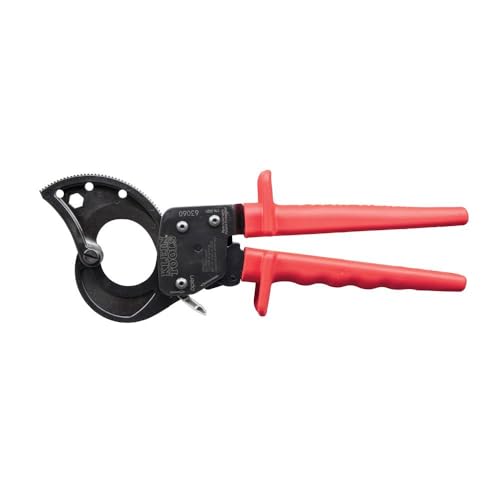
- Cuts up to 600 MCM copper and 750 MCM aluminum
- Two-step ratchet reduces strokes and hand force
- Quick-release and locking levers improve handling
Best For: Heavy-duty cable preparation and large-diameter cable
High-Capacity ACSR Cutter
Reduced-Force Ratcheting Cable Cutter

- Cuts up to 336 MCM ACSR
- Handles 400 MCM copper and 600 MCM aluminum
- Quick release and locking lever
Best For: Large copper, aluminum, and ACSR cable
Compact Precision Pick
240 mm² Ratcheting Cable Cutter
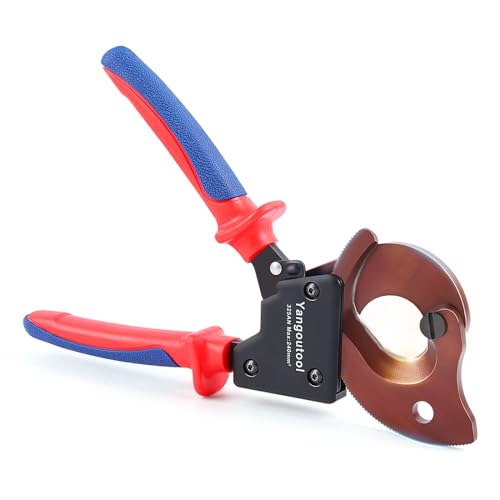
- Cuts copper and aluminum up to 240 mm²
- Centered blade supports two-way cutting
- Includes a plastic storage box
Best For: Electricians handling medium-to-large copper and aluminum cable
Industrial Copper/Aluminum Tool
500 MCM Ratcheting Cable Cutter

- Cuts up to 500 MCM aluminum
- Handles up to 4/0 AWG copper
- Safety release and non-slip grips
Best For: Heavy-duty copper and aluminum electrical cable
Best Heavy-Duty Capacity
Yangoutool 240mm² Ratchet Cable Cutter

- Cuts copper and aluminum cable up to 240mm²/600MCM
- Ratchet mechanism supports straight, low-effort cuts
- Compact ergonomic design for tight spaces
Best For: Large electrical cable projects using copper or aluminum
Best for Insulated Handles
VEVOR 600 MCM Ratcheting Cable Cutter

- 1000V-rated insulated handles for added protection
- Heat-treated steel body for demanding use
- Quick-release button simplifies blade resetting
Best For: Electrical installation and maintenance on de-energized cables
Best for Larger Cable Sizes
HKS 400mm² Ratchet Cable Cutter

- Handles copper and aluminum cable up to 400mm²/750MCM
- One-hand ratchet operation reduces cutting effort
- Quick-release button and compact design aid handling
Best For: Large single-conductor and multi-core cable cutting
Best Overall Capacity – Southwire Ratcheting Cable Cutter
For shoppers comparing ratcheting cable cutters for demanding electrical work, the Southwire CCPR400 combines controlled ratcheting action with a stated 750 MCM capacity. Its hardened steel blades are designed for clean cuts on copper and aluminum cable, while the molded ergonomic grip helps make repeated cuts more manageable.
Best For: Electrical repair and jobsite users who need high capacity for copper and aluminum cable.
Pros:
- Rated to cut copper and aluminum cable up to 750 MCM.
- Ratcheting action helps provide controlled cuts with fewer strokes.
- Ergonomic molded grip is intended to reduce hand fatigue.
- Hardened steel blades and durable construction support regular use.
Cons:
- At 1.7 pounds, it is heavier than some compact alternatives.
- The supplied notes do not specify a quick-release blade lever.
This is a strong all-around choice when cutting capacity and a comfortable grip matter more than minimizing tool weight.
Best for Smooth One-Handed Cuts – Knipex 95 31 250 SBA Cable Cutters
The Knipex 95 31 250 SBA is a focused option among ratcheting cable cutters, using precision-ground, hardened blades and a one-handed ratchet principle. It is designed for copper and aluminum cables, including single and multiple-wire cable, while its multi-component handles support a secure working grip.
Best For: Fleet and plant maintenance tasks involving copper and aluminum cable.
Pros:
- Supports one-handed operation using a ratchet principle.
- Precision-ground, hardened blades are designed for clean cuts.
- Helps cut cable without crushing or deforming it.
- Includes a limited lifetime manufacturer warranty.
Cons:
- Not suitable for ACSR, steel wire, or wire rope.
- The supplied details do not state a specific MCM capacity.
Knipex is a practical pick when cut quality and one-handed handling are priorities, provided your work does not involve steel-based cable or wire rope.
Best Compact Option – HKS Heavy-Duty Ratchet Cable Cutter
The HKS Cable Cutter 36D is a compact choice for ratcheting cable cutters, rated for copper and aluminum single-conductor or multi-core cables up to 300 mm², or AWG 600 MCM. Its high-transmission ratchet is intended to reduce cutting effort, and the quick-release lever allows the blade to open during operation.
Best For: Cutting copper and aluminum electrical cable in tight spaces.
Pros:
- Handles cable up to 300 mm², equivalent to AWG 600 MCM.
- Compact, lightweight design supports easier handling in confined areas.
- One-hand ratchet operation requires little force.
- Quick-release lever allows the blade to open at any cutting position.
Cons:
- Should not be used on steel, iron, or steel wire.
- The insulated handle does not make it suitable for cutting live cables.
- Its capacity is lower than the 750 MCM-rated options in this roundup.
This cutter stands out for portability and access in tight work areas, but users should follow the stated material and safety limitations carefully.
Best for Large-Diameter Cable – Klein Tools 63060 Ratcheting Cable Cutter
The Klein Tools 63060 is built for large-diameter cable preparation, cutting up to 600 MCM copper and 750 MCM aluminum. Its two-step ratchet mechanism is designed to reduce hand force and strokes, while the quick-release lever and locking lever make removal and transport more convenient.
Best For: Heavy-duty cable preparation where high capacity and reduced hand force are important.
Pros:
- Cuts up to 600 MCM copper and 750 MCM aluminum.
- Two-step ratchet mechanism requires fewer strokes per cut.
- Quick-release lever opens the blades in any cutting position.
- Locking lever keeps the handles closed for transport and storage.
Cons:
- It is designed for cutting rather than general-purpose wire work.
- The supplied notes list a one-year manufacturer warranty, shorter than Knipex’s stated warranty.
Choose the Klein when large cable capacity, a reduced-effort ratchet, and convenient blade release are more important than having the lightest tool.
High-Capacity ACSR Cutter – Reduced-Force Ratcheting Cable Cutter
Cable Cutters, Ratcheting Wire Cable Cutter Tool Cuts Copper, Aluminum, and ACSR
Check Price On AmazonIf you need ratcheting cable cutters for thick electrical cable, this model emphasizes reduced hand force and a two-step ratchet mechanism that requires fewer strokes per cut. Its hardened, selectively treated blades handle substantial copper, aluminum, and ACSR sizes.
Best For: Electricians and utility workers cutting large copper, aluminum, or ACSR cable.
Pros:
- Cuts up to 336 MCM ACSR, 400 MCM copper, and 600 MCM aluminum.
- Two-step ratchet mechanism helps reduce hand effort and strokes.
- Quick-release lever allows cable removal before completing a cut.
- Locking lever keeps the handles closed for transport.
Cons:
- At 1.5 pounds, it may be heavier than compact cable cutters.
- The supplied notes do not specify a dedicated storage case.
This is the strongest capacity-focused option in the group, particularly when ACSR cutting and reduced manual effort matter more than compact size.
Compact Precision Pick – 240 mm² Ratcheting Cable Cutter
These ratcheting cable cutters use incremental pressure to make large cable cuts with less strain. Polished edges, a centered blade, and an ergonomic handle support controlled cutting, while the included plastic box helps with storage and transport.
Best For: Electricians cutting copper or aluminum cables up to 240 mm², including armored cable and SER cable.
Pros:
- Rated for copper and aluminum cables up to 240 mm² or 17.5 mm in diameter.
- Centered blade supports cutting from two directions for added stability.
- Sharp polished edges are designed for smoother cuts.
- Includes a plastic storage box.
Cons:
- Not intended for steel or live wires.
- Its stated capacity is lower than the largest cutter in this roundup.
This model is a practical middle-ground choice for electricians who want a manageable ratcheting tool with broad copper and aluminum cable compatibility.
Industrial Copper/Aluminum Tool – 500 MCM Ratcheting Cable Cutter
For demanding electrical work, these ratcheting cable cutters combine a high-leverage gear drive with contoured blades designed to produce clean cuts in copper and aluminum conductors. A safety release lets you pause or release the blade during operation.
Best For: Industrial, marine, construction, and panel work involving thick copper or aluminum cables.
Pros:
- Cuts up to 4/0 AWG copper, 500 MCM aluminum, or 240 mm².
- High-leverage ratchet supports one-handed cutting in tight spaces.
- Heat-treated, forged high-carbon steel construction is built for demanding use.
- Non-slip grips and a safety release lever improve handling control.
Cons:
- Not suitable for steel, ACSR, steel wire rope, or iron cables.
- Manual operation may not suit users seeking a powered cutter.
This is a capable choice for thick copper and aluminum conductors, but buyers should carefully match the tool to the cable material because steel-reinforced and steel cables can damage its blades.
Best Heavy-Duty Capacity – Yangoutool 240mm² Ratchet Cable Cutter
For buyers comparing ratcheting cable cutters for larger electrical work, the Yangoutool model offers a stated capacity of up to 240mm² or 600MCM. Its compact ratchet design is intended to produce straight cuts in copper and aluminum cable with less hand effort.
Best For: Large-scale copper and aluminum cable projects, especially where a compact tool is useful in tight spaces.
Pros:
- Handles copper and aluminum cables up to 240mm² or 600MCM.
- Ratchet action provides a secure grip and progressive cutting assistance.
- Compact, ergonomic design with aluminum, plastic, and rubber handle materials.
Cons:
- Not suitable for steel or steel wire.
- Must not be used on live wires.
Yangoutool is a practical choice when capacity and maneuverability matter more than cutting steel. Confirm your cable size and material before using it.
Best for Insulated Handles – VEVOR 600 MCM Ratcheting Cable Cutter
Among ratcheting cable cutters, the VEVOR stands out for its 1000V-rated insulated handles and quick-release button. It is designed for copper and aluminum cable cutting, with a heat-treated steel body for repeated electrical installation and maintenance tasks.
Best For: Electricians and maintenance users who want insulated handles, progressive ratcheting, and quick blade release.
Pros:
- Designed for copper and aluminum cables up to 600MCM, with the listing also specifying 240mm².
- 1000V-rated insulated handles provide added protection during non-live electrical work.
- Heat-treated steel body and quick-release button support frequent use and easy resetting.
Cons:
- Not designed for steel, steel wire, or iron wire.
- Insulation does not make it safe for cutting live cables.
- Its 1.4-pound weight may feel substantial for extended overhead use.
The VEVOR is a strong fit for routine electrical work where handle insulation and quick operation are useful. Treat the insulation as added protection, not permission to work on energized cables.
Best for Larger Cable Sizes – HKS 400mm² Ratchet Cable Cutter
For buyers needing greater stated capacity, the HKS is one of the larger ratcheting cable cutters in this roundup, handling copper and aluminum conductors up to 400mm² or AWG 750MCM. Its one-hand ratchet operation and compact format are suited to wiring tasks in confined spaces.
Best For: Cutting large single-conductor and multi-core copper or aluminum cables with limited hand force.
Pros:
- Rated to cut copper and aluminum cables up to 400mm² or AWG 750MCM.
- High-transmission ratchet principle supports one-hand operation with less force.
- Quick-release button lets the blade open during operation, while the compact design helps in tight spaces.
Cons:
- Cannot be used on steel, steel wire, or iron wire.
- Despite the 1000V-insulated handle, it must not be used on live cables.
- The supplied specifications list a 0.87 kg weight, which may be more than needed for small wiring.
The HKS makes the most sense when cable diameter is the deciding factor. Its higher capacity and quick-release feature add flexibility, while the material restrictions remain important.
How We Picked the Best Ratcheting Cable Cutters
We focused on the features that matter most during real cable-preparation work: stated cutting capacity, compatibility with copper and aluminum conductors, blade and frame construction, ratchet smoothness, handle comfort, release controls, and portability. We also considered whether each tool appears suited to occasional repairs, routine electrical installation, or demanding professional use.
Capacity claims should be treated as a starting point rather than a guarantee. Cable diameter, insulation thickness, conductor configuration, and cable flexibility can all affect performance. Always confirm the manufacturer’s specifications before cutting a specific cable.
Quick Comparison
| Best For | What to Prioritize |
|---|---|
| General electrical work | Moderate capacity, smooth ratcheting, comfortable grips |
| Large conductors | High AWG or square-millimeter rating and rigid construction |
| Frequent professional use | Hardened blades, dependable release, replaceable or serviceable parts |
| Occasional repairs | Useful capacity without unnecessary bulk or cost |
Key Buying Factors for Ratcheting Cable Cutters
Cutting Capacity and Cable Type
Check both the maximum conductor size and the materials supported. Many cutters handle copper and aluminum, while some also list ACSR or multi-core cable compatibility. Do not assume a tool rated for a large single conductor will perform equally well on thick, tightly bundled cable.
Blade and Frame Construction
Hardened steel or spring-steel blades generally offer better edge retention and cleaner cuts. A strong frame helps keep the blades aligned under load. Look for polished cutting edges, corrosion-resistant finishes, and construction that does not flex noticeably during operation.
Ratcheting Mechanism and Release
A good mechanism advances smoothly through the cut and holds the cable securely between squeezes. A quick-release button or accessible manual release is especially useful if the cable is positioned incorrectly or the cut needs to be stopped.
Ergonomics and Portability
Longer handles can increase leverage but also add weight and reduce portability. Molded or PVC-coated grips improve comfort, while a compact design may be preferable for panels, vehicles, and cramped job sites. Consider whether you will make a few high-force cuts or many cuts in one session.
Who Should Buy Which Ratcheting Cable Cutters?
Choose a compact, moderately rated model for household repairs, light maintenance, and smaller electrical cables. An everyday professional option with hardened blades and comfortable handles is better for installers who need consistent performance across varied copper and aluminum conductors. For utility, industrial, or heavy-gauge work, prioritize the highest verified capacity, a rigid frame, and a reliable release system—even if the tool is larger and heavier.
Before buying, compare the cutter’s rating with your largest cable, not your average cable. If your work regularly approaches the stated maximum, moving up to a higher-capacity model can improve control and extend tool life.