The best emergency radios for hiking help you receive weather alerts, monitor local broadcasts, or stay in contact when cellular service is unavailable. The right choice depends on whether you prioritize simple emergency updates, long battery life, or two-way communication.
This roundup compares 10 options, from compact NOAA receivers and hand-crank radios to waterproof walkie-talkies and satellite communicators. Use the guide below to match the features to your hiking style and emergency plan.
Best 10 Emergency Radios for Hiking Picks for 2026
Best All-Purpose Pick

- NOAA weather scan and alert capability
- Solar power plus six included AA batteries
- Flashlight, SOS signal, and dog whistle
Best For: Day hikes and general emergency preparedness
Best for Off-Grid Messaging
Garmin inReach Mini 2 Satellite Communicator

- Two-way messaging beyond cell service
- Interactive SOS with active subscription
- Up to 14 days of tracking-mode battery life
Best For: Remote hikers needing satellite communication
Best High-Capacity Backup
10000mAh Hand Crank Weather Radio

- 10000mAh battery for emergency phone charging
- Solar, hand-crank, and USB-C charging
- IPX6 splash-resistant body with lights
Best For: Camping and hiking backup power
Best for Hiking Groups
Retevis RB48 Rugged Walkie Talkies

- IP67 waterproof and dustproof construction
- Two license-free FRS radios included
- Rechargeable batteries rated for up to 20 hours
Best For: Hiking partners needing direct radio communication
Best All-in-One Weather Radio
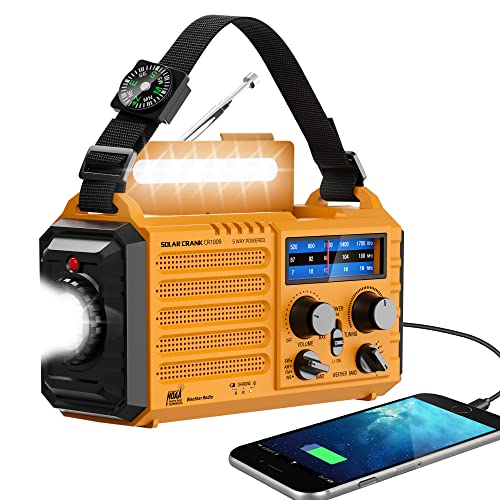
- NOAA alerts with audible alarm and flashing light
- Five charging and battery options
- Flashlight, reading lamp, compass, and USB output
Best For: Hikers wanting weather alerts, lighting, and backup power in one device
Best Waterproof Two-Way Radio
Retevis Ailunce HA1G GMRS Radio

- IP67 waterproof design for harsh outdoor conditions
- NOAA weather channels and emergency alarm
- 2800mAh battery with USB-C charging
Best For: Groups needing durable two-way communication on wet or rugged hikes
Best Floating Pair for Groups

- IP67 waterproof radios float face up
- License-free FRS with 22 channels
- Rechargeable two-pack with flashlights
Best For: Pairs and groups hiking near water
Self-Powered Preparedness
Solar Hand Crank Weather Radio
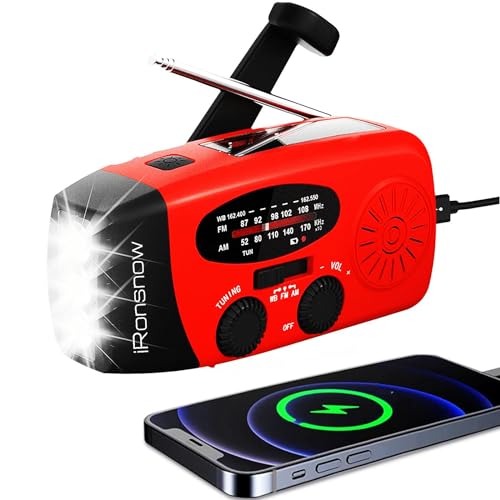
- NOAA, AM/FM, and weather-alert reception
- Solar, hand-crank, and USB-C charging
- Flashlight, SOS alarm, and 2,000mAh battery
Best For: Hikers needing multiple charging options and emergency lighting
Rugged Trail Communications
Retevis Ailunce HA1UV Ham Radio

- IP67 waterproof, dustproof, and dropproof build
- Two-way U/V-band operation with 256 channels
- NOAA alerts, SOS, and 2,800mAh USB-C battery
Best For: Prepared hikers and groups needing durable two-way communication
Ultralight Trail Updates
Retekess PR15 Pocket NOAA Radio
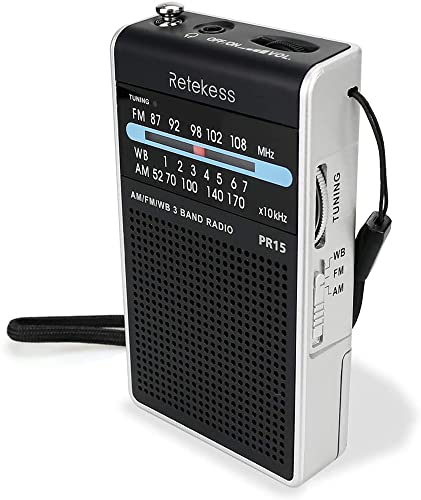
- AM/FM and NOAA weather-band reception
- Only 2.4 ounces with a pocket-friendly design
- Uses two AAA batteries and supports headphones
Best For: Lightweight hikers wanting simple weather and news reception
Best All-Purpose Pick – Midland ER310 Emergency Radio
The Midland ER310 is a practical choice for hikers who want emergency radios for hiking with several backup power options. It combines AM/FM and NOAA weather scanning with a flashlight, ultrasonic dog whistle, and support for six included AA batteries, though its housing is not water resistant.
Best For: Day hikes, emergency kits, and outdoor users who want a traditional weather radio with multiple alert and lighting features.
Pros:
- Supports multiple power sources, including solar power and six included AA batteries.
- NOAA weather scan and alert capability helps hikers monitor changing conditions.
- Built-in flashlight, SOS function, and ultrasonic dog whistle add useful emergency tools.
- USB connectivity can support compatible smartphones and tablets.
Cons:
- It is not water resistant, so it needs protection in wet conditions.
- At 9.61 inches long, it is less compact than some hiking-focused communicators.
The ER310 is a capable preparedness radio when weather alerts, lighting, and flexible battery options matter more than waterproofing or satellite communication.
Best for Off-Grid Messaging – Garmin inReach Mini 2 Satellite Communicator
The Garmin inReach Mini 2 takes a different approach to emergency radios for hiking. It is a compact satellite communicator that supports two-way messaging and interactive SOS beyond cell service, but an active satellite subscription is required and it does not replace an AM/FM or NOAA broadcast radio.
Best For: Remote hikers who need two-way communication, location sharing, navigation support, and SOS access outside cellular coverage.
Pros:
- Enables two-way messaging and interactive SOS globally with an active subscription.
- TracBack routing and a digital compass support navigation.
- Water-resistant design and compact 2.04-by-1.03-by-3.9-inch body suit backcountry use.
- Battery life reaches up to 14 days in 10-minute tracking mode.
Cons:
- An active satellite subscription is required for messaging and SOS features.
- It is a communicator rather than an AM/FM or NOAA broadcast radio.
- Satellite-device use may be regulated or prohibited in some jurisdictions.
For serious remote travel, the Mini 2 offers communication and navigation capabilities that conventional emergency radios cannot provide, provided you account for subscription costs and local regulations.
Best High-Capacity Backup – 10000mAh Hand Crank Weather Radio
This hand crank model is a useful option for emergency radios for hiking when backup power and lighting are priorities. Its 10000mAh internal battery can provide approximately 1–1.5 iPhone 14 charges, while solar, hand-crank, and USB-C charging help keep the unit usable away from an outlet.
Best For: Hikers, campers, and emergency-kit users who want a power bank, flashlight, reading lamp, compass, and manually tuned NOAA/AM/FM radio in one unit.
Pros:
- Large 10000mAh battery provides emergency USB phone charging.
- Offers solar, hand-crank, and USB-C charging options.
- IPX6 water resistance helps protect against water spray and splashing.
- Three-mode flashlight, reading lamp, and built-in compass add outdoor utility.
Cons:
- NOAA listening requires manual tuning and does not support automatic or SAME alerts.
- IPX6 protection is for splashing and spray, not immersion or heavy rain.
- Actual phone charging and runtime vary due to conversion loss and use conditions.
This radio offers a strong feature set for preparedness, especially when charging and lighting are as important as weather broadcasts. Its manual NOAA operation is the main trade-off.
Best for Hiking Groups – Retevis RB48 Rugged Walkie Talkies
The Retevis RB48 is a two-way communication option for groups comparing emergency radios for hiking. This two-pack uses license-free FRS channels and combines IP67 waterproofing, MIL-STD-810H durability, a rechargeable 2000mAh battery, and weather alert support for demanding outdoor conditions.
Best For: Hiking partners and outdoor groups who need direct radio-to-radio communication rather than broadcast weather listening or satellite messaging.
Pros:
- IP67 waterproof and dustproof construction with 2-meter drop resistance.
- Two included radios support group communication over 22 license-free FRS channels.
- Rechargeable 2000mAh batteries provide up to 20 hours of battery life.
- Glove-friendly controls, dual PTT, weather alerts, and bright yellow housings aid trail use.
Cons:
- It communicates with nearby compatible FRS radios rather than satellite networks.
- Claimed range depends on terrain and conditions; the supplied range figure is up to 300,000 square feet or 25 floors.
- The 730-gram listed item weight may be substantial for ultralight hikers.
For groups that may separate on a trail, the RB48 provides rugged, rechargeable short-range communication. It is best viewed as a partner-to-partner tool, not a standalone weather broadcast or global SOS device.
Best All-in-One Weather Radio – Eoxsmile Emergency Radio
For hikers who want broad emergency coverage in a single device, the Eoxsmile is a versatile choice among emergency radios for hiking. It combines NOAA alerts, AM/FM/shortwave reception, multiple charging options, lighting, and a USB phone-charging output.
Best For: Hikers and campers who prioritize weather alerts, lighting, and backup power in one compact radio.
Pros:
- NOAA weather alerts include an audible SOS alarm and flashing red light.
- Five power options include solar, hand crank, USB, a rechargeable battery, and AAA backup batteries.
- Includes a 3W flashlight, adjustable reading lamp, compass, and USB output for charging phones.
- Supports AM, FM, shortwave, and a 3.5mm headphone connection.
Cons:
- AAA batteries and the 5V/2A power plug are not included.
- The stated FM playback runtime is up to 13 hours when fully charged.
This is a strong multipurpose option for solo hikers or emergency kits, especially when weather monitoring and illumination matter as much as radio listening. Its larger feature set may be more than hikers who only need two-way communication require.
Best Waterproof Two-Way Radio – Retevis Ailunce HA1G GMRS Radio
The Retevis Ailunce HA1G is a communication-focused pick among emergency radios for hiking. Its IP67 waterproof rating, NOAA channels, rechargeable 2800mAh battery, and emergency alarm make it suited to groups traveling through wet or demanding conditions.
Best For: Hiking groups, off-road travelers, and outdoor users who need durable two-way communication and weather information.
Pros:
- IP67 waterproof construction helps it handle rain, splashes, mud, and snow.
- Provides 12 NOAA channels with weather information and alerts.
- 2800mAh battery and USB-C charging support extended outdoor use.
- Includes VOX, repeater channels, emergency alarm, FM radio, and a backlit color screen.
Cons:
- Its GMRS features and repeater support make it more involved than a basic broadcast radio.
- The listed maximum talking range is up to 5 miles, and actual range varies with terrain.
Choose this model when staying in contact with companions is the main goal. It offers substantially more two-way flexibility than a conventional emergency broadcast radio, but hikers should be comfortable with its GMRS-oriented controls and features.
Best Floating Pair for Groups – Motorola T605 H2O Talkabout
The Motorola T605 H2O is a practical two-pack for hikers who want simple group communication without licensing complexity. These emergency radios for hiking offer 22 FRS channels, privacy codes, waterproof construction, and a floating design that keeps each radio face up in water.
Best For: Hiking pairs and groups near water who want easy-to-use, rechargeable walkie-talkies.
Pros:
- IP67 waterproof radios float face up for easier retrieval.
- FRS operation is license-free, with easy pairing across 22 channels.
- Includes 121 privacy codes per channel for many channel combinations.
- Rechargeable design, USB-C charging, backlit display, and integrated flashlights improve trail convenience.
Cons:
- The listed battery average life is 9 hours.
- This is a two-way FRS radio rather than a dedicated NOAA broadcast radio.
For straightforward communication between hiking partners, the T605 H2O is an appealing, low-fuss choice. Its floating waterproof design is particularly useful around streams, lakes, and wet-weather routes, while the included two-pack supports immediate group use.
Self-Powered Preparedness – Solar Hand Crank Weather Radio
For hikers who want multiple backup power options, this compact emergency radio for hiking combines AM/FM and NOAA weather reception with USB-C charging, solar charging, and a hand crank. Its flashlight and SOS functions add useful visibility and signaling capability on the trail.
Best For: Hikers who want weather alerts, emergency lighting, and a way to recharge a phone without relying on a wall outlet.
Pros:
- Uses USB-C, solar, and hand-crank charging methods.
- Includes NOAA weather reception and alerts for severe weather events.
- Features a 2,000mAh battery, power-level indicator, flashlight, and SOS alarm.
- Compact 5 x 1.8 x 2.4-inch design weighs 7.84 ounces.
Cons:
- The included phone-charging function is intended for emergency use rather than replacing a dedicated power bank.
- The product notes mention that versions with different flashlight configurations may ship randomly.
This is a versatile choice when self-powered operation matters most. It offers more emergency features than a basic pocket radio, while remaining small enough for a hiking or camping kit.
Rugged Trail Communications – Retevis Ailunce HA1UV Ham Radio
For hikers who need two-way communication rather than one-way broadcasts, this emergency radio for hiking is a rugged dual-band handheld with IP67 protection, NOAA alerts, and a 2,800mAh USB-C rechargeable battery. It is designed for users who are comfortable with ham-radio setup and operation.
Best For: Prepared hikers and groups who need a durable two-way radio with weather alerts, long battery life, and programmable channels.
Pros:
- IP67 waterproof, dustproof, and dropproof construction.
- Offers 256 memory channels, VFO manual entry, and CHIRP compatibility.
- Includes 12 NOAA channels with real-time weather alerts.
- Provides a 2,800mAh battery, USB-C charging, SOS alarm, and SOS signal light.
Cons:
- As a ham radio, it requires more setup and operating knowledge than a simple weather receiver.
- Its two-way communication range depends on conditions and compatible frequencies; the listed maximum is 5 miles.
- It is substantially heavier than a pocket weather radio at 337 grams.
This is the most capable communications-focused option in the group. Choose it when group coordination and rugged weather protection are more important than minimum weight or plug-and-play simplicity.
Ultralight Trail Updates – Retekess PR15 Pocket NOAA Radio
If pack weight is your main concern, this pocket-sized emergency radio for hiking provides AM, FM, and weather-band reception in a 2.4-ounce body. It runs on two AAA batteries and includes a speaker plus a 3.5mm headphone jack for receiving news and weather updates on the move.
Best For: Day hikers and lightweight packers who want a simple battery-powered weather and broadcast radio.
Pros:
- Extremely light and compact at 3.5 x 2.2 x 0.7 inches and 2.4 ounces.
- Receives FM, AM, and NOAA weather-band broadcasts.
- Runs on commonly available two AAA batteries.
- Offers both a built-in speaker and 3.5mm headphone output.
Cons:
- It does not include solar, hand-crank, or rechargeable power options.
- It is a receive-only pocket radio rather than a two-way communication device.
- Headphones are not included.
The PR15 is a straightforward choice for hikers who want essential broadcasts with almost no pack penalty. Its simple AAA-battery design makes it easy to carry, though it lacks the backup charging and signaling features of larger emergency radios.
How We Picked the Best Emergency Radios for Hiking
We focused on practical equipment for trail emergencies, changing weather, and limited or nonexistent cell coverage. The selection includes NOAA weather receivers, AM/FM radios, hand-crank and solar charging options, two-way FRS, GMRS, and ham radios, plus a satellite communicator. We considered portability, power options, weather resistance, communication range, alert capability, battery capacity, and how much setup or licensing each device requires.
These devices serve different purposes. A weather radio can receive alerts but usually cannot communicate with other hikers, while a walkie-talkie supports group communication but may not receive every emergency broadcast. Satellite devices can send messages beyond cellular networks, but they require a clear sky view, an account, and typically a subscription.
Quick Comparison
| Type | Best For | Main Advantage | Important Limitation |
|---|---|---|---|
| NOAA weather radio | Weather monitoring | Alerts and broadcasts | Usually receive-only |
| Hand-crank or solar radio | Power outages and backup kits | Manual recharging options | Charging can be slow |
| FRS walkie-talkie | Hiking groups | No license required in the U.S. | Range varies significantly by terrain |
| GMRS radio | Longer-range group communication | Higher-power operation | Requires an FCC license in the U.S. |
| Ham radio | Experienced radio users | Flexible communication potential | Operator licensing and setup required |
| Satellite communicator | Remote check-ins and SOS messaging | Works beyond cellular coverage | Requires compatible service and a subscription |
Key Buying Factors for Emergency Radios for Hiking
Weather Alerts and Reception
Choose a radio with NOAA Weather Radio support if storm and hazard updates are the priority. An alert function can notify you when severe weather is broadcast, but reception depends on location, terrain, and proximity to a transmitter. AM/FM capability adds useful general news and local information.
Power and Battery Backup
Check battery capacity, charging speed, and whether the unit supports USB, solar, or hand-crank charging. A crank is a valuable backup, not always a convenient primary power source. For multi-day trips, bring a charged power bank and test the radio before departure.
Communication, Range, and Licensing
Walkie-talkies are useful when hikers remain within radio range, but advertised distances are measured under ideal conditions. Mountains, forests, and buildings can reduce range sharply. FRS radios are generally the simplest option; GMRS and ham radios may offer more capability but involve licensing and configuration requirements.
Durability and Packability
Look for water resistance, impact protection, a secure battery compartment, readable controls, and a weight that fits your pack. IP ratings are helpful, but verify whether the device is rated for temporary submersion or only rain and splashes. A bright color, flashlight, or emergency siren can also improve visibility and usefulness.
Who Should Buy Which Emergency Radios for Hiking?
- For basic weather awareness: Choose a compact NOAA weather radio such as a pocket-style receiver.
- For emergency preparedness: Pick a hand-crank or solar model with NOAA, AM/FM, USB output, and a built-in light.
- For hiking groups: FRS walkie-talkies are convenient when everyone stays within practical range.
- For wet or rugged trips: Consider a waterproof GMRS or FRS radio, while checking licensing requirements.
- For experienced radio operators: A waterproof ham radio offers more flexibility when properly licensed and programmed.
- For remote solo hikes: A satellite communicator is the strongest option for off-grid check-ins and SOS messaging, provided you maintain an active service plan.
Whichever type you choose, carry a backup navigation method, keep emergency contacts current, and test the device in the area where you plan to use it. No radio replaces preparation, location sharing, weather awareness, and a clear turnaround plan.