When the power goes out or severe weather disrupts communications, an emergency radio with a phone charger can provide critical alerts, light, and limited backup power in one compact device.
We selected 10 options with different battery capacities, charging methods, radio bands, lighting features, and portability profiles so you can match the radio to your emergency kit, home, vehicle, or outdoor plans.
Best 10 Emergency Radios with Phone Charger Picks for 2026
Best Overall
Raynic 5000mAh NOAA Emergency Radio

- Automatic NOAA alerts with LCD tuning display
- Six charging options, including solar and hand crank
- Flashlight, reading lamp, SOS siren, and phone charging
Best For: All-around home and outdoor preparedness
Best Compact Pick
RunningSnail 2000mAh Hand Crank Radio

- Lightweight pocket-sized design
- 2000mAh USB phone charger
- Solar, hand-crank, and rechargeable power
Best For: Portable emergency kits and travel
Best High-Capacity Option
12000mAh Solar Hand Crank Radio

- 12000mAh battery for longer emergency use
- Large 8500mm² solar panel and hand-crank generator
- AM/FM/NOAA radio with flashlight and reading lamp
Best For: Extended outages and off-grid use
High-Capacity Backup

- 4000mAh battery for emergency USB device power
- NOAA, AM, and FM reception
- Solar, hand-crank, and USB charging
Best For: Home storm kits and extended outage preparedness
Pocket-Sized Value
WVL Compact Phone-Charging Weather Radio
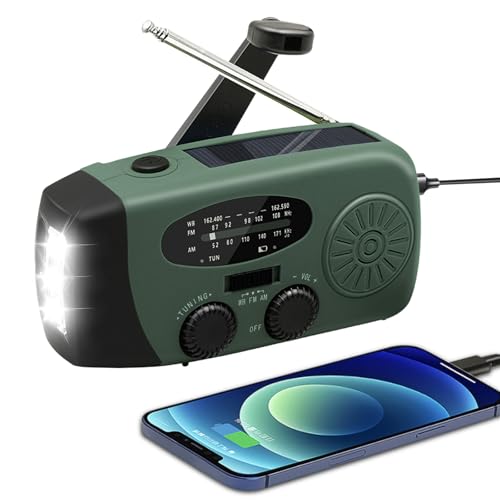
- 2000mAh emergency phone charger
- Compact 231g design
- NOAA, AM, and FM reception
Best For: Go-bags, camping, and lightweight travel kits
Wireless Charging Pick
22000mAh Bluetooth Emergency Radio

- 22000mAh battery with USB-C power bank
- Up to 15W wireless phone charging
- FM, Bluetooth, lighting, and SOS functions
Best For: High-capacity home backup, camping, and RV use
Most Versatile

- Six-way power design with solar and hand-crank charging
- AM/FM, shortwave, and NOAA weather reception
- USB phone charging plus flashlight, lamp, and SOS beacon
Best For: Preparedness kits needing broad coverage and flexible power
Best Power Bank
FosPower A1 Emergency Weather Radio

- 7400mWh (2000mAh) power bank for small devices
- Solar, hand-crank, and AAA-battery power options
- AM/FM and NOAA reception with two built-in lights
Best For: Users who prioritize phone-charging capacity in a compact radio
Best Digital Tuning

- Digital display shows frequency, battery, and signal strength
- AM/FM/LW/SW and NOAA weather coverage
- Solar, hand-crank, rechargeable, and AC power options
Best For: Home preparedness and travelers wanting precise tuning
Best Overall – Raynic 5000mAh NOAA Emergency Radio
For shoppers comparing emergency radios with phone charger, the Raynic CR1009Pro stands out as a feature-rich option with automatic NOAA alerts, multiple charging methods, and a clear LCD display. It is designed for home preparedness as well as camping, hiking, and other outdoor use.
Best For: Households wanting automatic weather alerts, broad radio-band support, and several backup power options.
Pros:
- Automatically scans for NOAA emergency and weather alerts, including in standby mode.
- Supports six charging options, including USB-C, solar power, hand crank, rechargeable battery, and AAA batteries.
- Includes a 3W flashlight, 2.5W reading lamp, USB phone charger, SOS siren, and headphone jack.
- Large HD LCD display shows tuning frequency and battery level.
Cons:
- At 1.2 pounds, it is heavier than some pocket-sized emergency radios.
- Its IPX3 water resistance is intended for light exposure rather than submersion.
The Raynic is a strong all-around pick when alert automation and operating flexibility matter more than the smallest possible size. Its combination of information, lighting, charging, and signaling features makes it well suited to a home emergency kit.
Best Compact Pick – RunningSnail 2000mAh Hand Crank Radio
The RunningSnail is a compact choice for anyone seeking emergency radios with phone charger capabilities without adding much bulk to a go-bag. It combines AM/FM/NOAA reception, a 2000mAh power bank, and three charging sources in a lightweight design.
Best For: Travelers, campers, and emergency kits where low weight and easy portability are priorities.
Pros:
- Small 5 x 1.8 x 2.4-inch body weighs about 0.5 pound.
- Provides a 2000mAh USB phone charger for emergency communication.
- Runs from its rechargeable battery, solar panel, or hand crank.
- Includes NOAA weather alerts, a 1W LED flashlight, and an 18-month warranty.
Cons:
- Its 2000mAh battery is smaller than the capacities offered by the other listed models.
- It supports AM, FM, and NOAA but does not include shortwave reception.
This is a sensible minimalist option for keeping basic weather information, light, and phone power available during an outage. Its smaller battery favors portability over extended charging capacity.
Best Cable Convenience – PRUNUS J-366 Emergency Radio
The PRUNUS J-366 makes emergency radios with phone charger functionality especially convenient by building Lightning, USB-C, and Micro USB cables into the unit. It also adds automatic NOAA alerts, five power options, and a compact body for home kits, backpacks, or vehicles.
Best For: Users who want built-in charging connectors for multiple phone types and a lightweight emergency radio.
Pros:
- Built-in 3-in-1 charging cable supports Lightning, USB-C, and Micro USB devices.
- 7400mWh rechargeable battery is supplemented by USB-C, solar, hand-crank, and AAA-battery power.
- NOAA alert mode sounds an alarm when warnings are issued.
- Compact 5.6 x 2 x 2.7-inch design weighs 8.6 ounces and includes a lanyard.
Cons:
- AAA batteries are not included.
- The supplied details list FM as the tuner type even though the radio bands include AM, FM, and NOAA.
The J-366 is particularly practical when you may not have a separate charging cable available. Its integrated connectors and compact form make it a convenient grab-and-go choice, while the SOS feature and antenna add useful emergency functionality.
Best High-Capacity Option – 12000mAh Solar Hand Crank Radio
For buyers prioritizing battery capacity in emergency radios with phone charger support, this solar hand-crank model offers a stated 12000mAh lithium battery alongside solar, USB-C, hand-crank, and AAA-battery power. Its large solar panel, strong lighting, and clear AM/FM/NOAA reception suit longer outages and off-grid use.
Best For: Households and outdoor users who want extended power reserves, bright lighting, and multiple charging backups.
Pros:
- Large 12000mAh lithium battery is designed to keep phones, radio functions, and lights running longer.
- Uses an 8500mm² monocrystalline solar panel and an upgraded hand-crank generator.
- Includes AM/FM/NOAA reception, a flashlight with up to a 260-foot beam, and a soft reading lamp.
- Offers five power sources, including USB-C input and three AAA batteries.
Cons:
- Its 6.8 x 2.9 x 4.7-inch body is larger than the compact models in this roundup.
- The supplied notes advise fully charging the unit before first use.
This model is the capacity-focused choice for extended blackouts, storm preparation, and off-grid trips. It trades compactness for a larger battery, substantial solar panel, and more capable lighting system.
High-Capacity Backup – 4000mAh NOAA Emergency Radio
For shoppers seeking emergency radios with phone charger capability, this Nitigo model combines NOAA, AM, and FM reception with a 4000mAh rechargeable battery. Its solar panel, hand crank, and USB charging options provide flexibility during outages, while the adjustable antenna is designed for stronger reception.
Best For: Home emergency kits, storm preparedness, and users who want a larger battery with multiple charging methods.
Pros:
- 4000mAh battery can provide emergency power to USB devices such as smartphones.
- Receives NOAA weather alerts along with AM and FM broadcasts.
- Includes a flashlight, rotating reading lamp, SOS alarm, and headphone jack.
- Solar, hand-crank, and USB charging support backup use.
Cons:
- The supplied notes do not specify the exact phone-charging output.
- Its larger battery-focused design may be more than needed for minimal carry kits.
This is a versatile choice if battery capacity and broad radio coverage matter most. The combination of NOAA alerts, lighting, and emergency phone power makes it a practical all-around preparedness tool.
Pocket-Sized Value – WVL Compact Phone-Charging Weather Radio
This compact WVL model is one of the more portable emergency radios with phone charger functionality, pairing a 2000mAh charger with NOAA, AM, and FM reception. Its hand crank, solar panel, and rechargeable battery offer three ways to keep the unit operating when normal power is unavailable.
Best For: Lightweight emergency kits, travel, camping, and shoppers prioritizing portability.
Pros:
- Small 130 × 50 × 60mm design weighs about 231g.
- 2000mAh charger can provide emergency power to phones or small tablets.
- Includes a 1.5W LED flashlight, motion-sensor reading lamp, and SOS alarm.
- Offers hand-crank, solar, and built-in rechargeable-battery power options.
Cons:
- The 2000mAh capacity is lower than some larger emergency radios.
- The supplied details do not specify the phone-charging output or charging speed.
Choose this radio when packability is more important than maximum battery capacity. Its compact form and multiple backup power options make it easy to add to a go-bag or travel kit.
Wireless Charging Pick – 22000mAh Bluetooth Emergency Radio
For shoppers comparing emergency radios with phone charger features, this Semmorn model stands out with a 22000mAh battery, USB-C output up to 20W, and wireless phone charging up to 15W for compatible smartphones. It also adds FM radio, Bluetooth playback, solar and hand-crank backup power, and several lighting functions.
Best For: Users who want high-capacity backup charging and wireless-phone compatibility alongside emergency lighting and FM broadcasts.
Pros:
- Large 22000mAh battery supports USB-C power-bank charging.
- Offers up to 20W USB-C charging and up to 15W wireless charging for compatible phones.
- Includes NOAA and FM broadcasts, Bluetooth connectivity, flashlight, reading lamp, and SOS signal.
- Supports USB-C, solar, and hand-crank charging.
Cons:
- AM reception is not supported; the supplied notes identify FM as the tuner.
- Wireless charging requires a compatible smartphone.
- Actual solar and hand-crank performance varies with conditions and usage.
This is the strongest fit for buyers who value phone-charging capacity and modern connectivity. Its FM-focused setup and wireless charging make it especially useful for home backup, travel, camping, and RV use.
Most Versatile – Kaito KA500 Emergency Radio
The Kaito KA500 is a flexible choice among emergency radios with phone charger, offering solar, hand-crank, battery, and USB-powered operation. It combines AM/FM, shortwave, and NOAA weather coverage with lighting and a USB output for charging compatible mobile devices.
Best For: Households and outdoor users who want broad radio coverage, multiple power options, and several built-in lights.
Pros:
- Supports hand-crank, solar, rechargeable battery, AA batteries, and USB or AC/DC input.
- Receives AM, FM, two shortwave bands, and seven NOAA weather channels.
- Includes a 5V USB charging output, reading lamp, flashlight, and SOS beacon.
- Uses impact-resistant, water-resistant ABS construction.
Cons:
- Three AA batteries are required but not included.
- The wall power adapter is sold separately.
- NOAA weather coverage is specified for the USA and Canada only.
With its extensive band selection and six-way power design, the KA500 is well suited to preparedness kits that need one device for information, illumination, and basic phone charging.
Best Power Bank – FosPower A1 Emergency Weather Radio
The FosPower A1 is a compact option among emergency radios with phone charger, built around a 7400mWh (2000mAh) power bank for small tablets or phones. Its solar panel and hand crank help replenish the unit, while AAA batteries provide another way to keep it operating.
Best For: Users prioritizing an integrated phone-charging power bank, emergency lighting, and a compact water-resistant design.
Pros:
- Includes a 7400mWh (2000mAh) power bank for small tablets and phones.
- Offers solar, hand-crank, and AAA-battery power options.
- Provides AM/FM and NOAA weather broadcasts, plus an SOS alarm.
- Combines a 1W flashlight with a four-LED reading light.
Cons:
- Four AAA batteries are required and not included.
- Its radio coverage is limited to AM, FM, and weather bands rather than shortwave.
- The supplied notes do not specify an AC power option.
The A1 stands out when charging capacity matters most. Its dedicated power bank and multiple recharge methods make it a practical choice for short-term outages and emergency go-bags.
Best Digital Tuning – Kaito Voyager Pro KA600
The Kaito Voyager Pro KA600 combines digital tuning with AM/FM, longwave, shortwave, and NOAA reception, making it a capable choice among emergency radios with phone charger. Its solar panel, hand crank, rechargeable battery, and included AC adapter support preparedness at home or on the go.
Best For: Buyers who want a digital display, precise tuning, broad band coverage, and built-in lighting for outages or travel.
Pros:
- Digital display shows frequency, battery level, and signal strength.
- Receives AM/FM/LW/SW and NOAA weather channels with real-time alerts.
- Includes solar, hand-crank, rechargeable-battery, and corded-electric power options.
- Features a flashlight, adjustable reading lamp, and smartphone charger.
Cons:
- Three AA batteries are required.
- Its larger dimensions may be less convenient than more compact emergency radios.
- The supplied notes do not specify the charger’s output capacity for smartphones.
The KA600 is a strong fit for users who prefer readable digital controls and extensive radio-band support. The included AC adapter also makes it convenient as a home emergency-radio option.
How We Picked the Best Emergency Radios with Phone Charger
We focused on practical emergency features rather than headline specifications alone. The selected models offer some combination of NOAA weather reception, AM/FM or shortwave bands, hand-crank and solar charging, internal battery capacity, flashlights, reading lamps, and USB phone charging. We also considered versatility, portability, charging flexibility, and whether each radio suits occasional backup use or more demanding preparedness setups.
Battery-capacity claims can vary by manufacturer and may not translate directly into a full smartphone charge. Treat the phone-charging function as an emergency backup, not a replacement for a power bank.
Quick Comparison
| Feature | What to look for | Best suited to |
|---|---|---|
| Radio coverage | NOAA plus AM/FM; shortwave or LW adds flexibility | Weather monitoring and broader emergency news |
| Power options | Hand crank, solar, USB, and replaceable or rechargeable battery support | Long outages and off-grid use |
| Battery capacity | Higher mAh or mWh ratings generally provide more reserve | Phone charging and extended lighting |
| Lighting | Flashlight plus reading lamp or multiple brightness modes | Blackouts, shelters, and nighttime repairs |
| Portability | Compact housing, simple controls, and a secure handle | Go-bags, vehicles, and camping |
Key Buying Factors for Emergency Radios with Phone Charger
Charging Flexibility
A hand crank is useful when batteries are depleted, while solar charging works well during extended outages but depends on direct sunlight. USB input is typically the fastest option before an emergency. Choose a model with several charging methods so one weak method does not leave you without power.
Weather Alerts and Reception
NOAA capability is valuable in areas covered by NOAA broadcasts, particularly for storm and severe-weather information. AM/FM coverage helps with local news, while shortwave can broaden reception. Check that the controls and display are easy to use in darkness or under stress.
Phone-Charging Performance
Look for a stated battery capacity, a compatible USB output, and included charging cables when possible. Confirm your phone’s connector before buying. A higher-capacity radio may be heavier, so balance charging reserve against portability.
Lighting and Durability
A focused flashlight is useful for navigation, while a reading lamp provides broader illumination in a room or tent. Consider splash resistance, a sturdy crank handle, clear controls, and a design that can be stored without accidentally draining the battery.
Who Should Buy Which Emergency Radios with Phone Charger?
For a basic blackout kit, choose a compact model with NOAA, a flashlight, hand-crank charging, and a modest phone-charging output. Families preparing for longer outages should favor higher-capacity options with multiple lighting modes and several charging inputs. Campers and vehicle owners may prefer lighter radios with simple controls and solar support. Buyers who want the broadest listening options should consider models offering shortwave or longwave alongside AM/FM and NOAA. Whichever option you choose, test the radio, charging cable, crank, and solar panel periodically, then store it somewhere accessible with your emergency supplies.