Finding a refrigerant leak quickly can reduce service time, prevent repeat callbacks, and help protect system performance. The best infrared refrigerant leak detectors combine sensitive sensors with clear alarms, manageable probes, and controls that work in busy mechanical spaces.
This roundup compares 10 options for professional HVAC technicians, automotive service, maintenance teams, and homeowners who need a more dependable way to locate refrigerant leaks.
Best 10 Infrared Refrigerant Leak Detectors Picks for 2026
Ultra-Sensitive Pick

- Detects leaks below 0.03 oz/yr
- Supports major refrigerant types and A2L
- 17-inch probe with 10+ hour USB-C battery
Best For: Technicians prioritizing sensitive detection in tight spaces
Versatile Setting Pick

- Offers four sensitivity settings
- Automatic and manual zero modes
- Detects A2L and broad refrigerant categories
Best For: Users wanting adjustable controls and included field accessories
Multi-Gas Pick
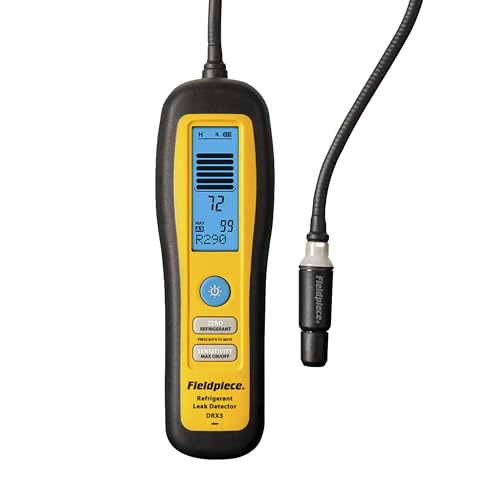
- Detects refrigerants and combustible gases
- Supports A3, A2L, A1, and tracer gases
- Includes app connectivity and three sensitivity levels
Best For: Technicians needing one tool for refrigerant and gas detection
Budget-Friendly Heated-Diode Pick

- Three sensitivity levels up to 0.1 oz/yr
- TFT display shows alerts and battery status
- Supports many halogenated refrigerants and blends
Best For: Users wanting clear readings and simple controls
Best Value
VIVOHOME Rechargeable Refrigerant Leak Detector

- Three sensitivity modes down to 0.03 oz./yr.
- LCD, reset, peak, audible, and visual alerts
- Rechargeable battery and broad refrigerant compatibility
Best For: DIY users and general HVAC or automotive troubleshooting
Professional Pick
Fieldpiece DR58 Heated Diode Leak Detector

- Detects leaks smaller than 0.03 oz./yr.
- 17-inch probe and 18-hour rechargeable battery
- IP54 construction and 300-hour sensor life
Best For: HVACR technicians handling frequent service calls
Budget Traditional Sensor
Elitech CLD-100 Refrigerant Leak Detector

- Six sensitivity settings and six-second preheating
- Audible and visual alarms for common refrigerants
- Lightweight design with UV lamp and flexible probe
Best For: Occasional users checking common HVAC or automotive refrigerants
Best Rechargeable Pick
Rechargeable Japanese-Sensor Leak Detector

- Three sensitivity levels with up to 3g/yr detection
- Sound, light, and vibration alerts
- USB-C charging with up to 8 hours of use
Best For: Technicians needing flexible, rechargeable leak detection
Best Long-Life Sensor
Elitech ILD-200 Infrared Leak Detector
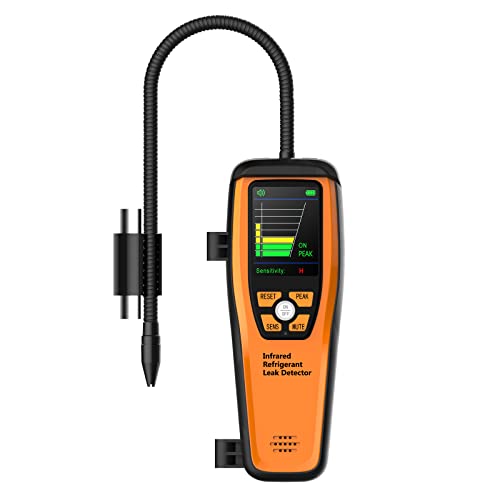
- Stated 10-year infrared sensor life
- Three adjustable sensitivity levels
- Large screen with peak leak indication
Best For: Professional HVAC and automotive gas detection
Best Fast-Response Pick
Elitech ILD-300 Infrared Leak Detector

- One-second stated response time
- Sensitivity up to 0.1 oz/yr
- TFT screen with battery and leak information
Best For: Fast HVAC and automotive leak-tracing work
Ultra-Sensitive Pick – Fieldpiece DR82
For technicians prioritizing sensitivity, the Fieldpiece DR82 is a strong choice among infrared refrigerant leak detectors. Its non-dispersive infrared sensor detects leaks smaller than 0.03 oz/yr and works with a broad range of refrigerants.
Best For: HVACR professionals who need highly sensitive detection and a flexible probe for tight spaces.
Pros:
- Detects micro leaks below 0.03 oz/yr.
- Compatible with CFC, HCFC, HFC, HFO, blends, and A2L systems.
- 17-inch probe, backlit LCD, LED tip, and audible leak indicators.
- USB-C battery provides more than 10 hours of operation, with a 10-year sensor life.
Cons:
- Its feature set may be more than needed for occasional users.
- Operation is battery powered, so charging or battery planning is required.
The DR82 combines very high sensitivity with a durable, moisture- and oil-resistant design. It is especially appealing when pinpointing small leaks in difficult-to-reach HVACR locations matters.
Versatile Setting Pick – INFICON D-TEK 3
The INFICON D-TEK 3 offers adjustable control for technicians comparing infrared refrigerant leak detectors. Four sensitivity levels, automatic and manual zero modes, and support for A2L refrigerants make it adaptable across service jobs.
Best For: HVACR technicians who want selectable sensitivity and flexible zeroing modes.
Pros:
- Provides low, medium, high, and super sensitivity settings.
- Includes both automatic and manual zero modes.
- Detects CFCs, HCFCs, HFCs, HFOs, blends, and A2Ls.
- Includes a sensor, lithium-ion battery, filters, wall charger, and rugged carrying case.
Cons:
- The supplied notes do not specify a detection threshold or battery runtime.
- Its larger listed dimensions may take up more tool-storage space.
With multiple operating modes and broad refrigerant compatibility, the D-TEK 3 is a practical general-purpose option. The included case and charging accessories also make it convenient for organized field work.
Multi-Gas Pick – Fieldpiece DRX3
The Fieldpiece DRX3 stands apart from many infrared refrigerant leak detectors by also detecting combustible gases. Its heated diode sensor supports A3, A2L, and A1 refrigerants, plus tracer gases and heating gases.
Best For: HVAC professionals who need one detector for refrigerants and combustible gases.
Pros:
- Detects A3, A2L, A1 refrigerants, and combustible gases.
- Supports refrigerants including HC, HFC, HCFC, CFC, HFO, and H2/N2 tracer gas.
- Offers auto and manual zero modes with three sensitivity levels.
- Provides changing visual and audio feedback and connects to the Job Link System app.
Cons:
- Uses four AA batteries rather than a rechargeable battery.
- At 2.99 pounds, it is heavier than the compact DR82 listed in this roundup.
The DRX3 is a compelling all-in-one tool when a service kit must cover both refrigerant and combustible-gas checks. Field-replaceable sensing and batteries support ongoing field use, while the case helps with transport.
Budget-Friendly Heated-Diode Pick – Elitech ILD-100H
The Elitech ILD-100H is a straightforward heated-diode option for shoppers comparing infrared refrigerant leak detectors. It provides three sensitivity levels, a TFT display, and compatibility with many halogenated refrigerants and blends.
Best For: HVAC users who want clear on-screen readings and simple sensitivity controls.
Pros:
- Adjustable low, medium, and high sensitivity, reaching up to 0.1 oz/yr.
- TFT screen displays sensitivity, leak alerts, and battery information.
- Detects a wide range of halogenated refrigerants and blends, including R22, R410A, R134A, and R1234yf.
- Front buttons provide quick sensitivity adjustment and buzzer muting.
Cons:
- Its maximum sensitivity is less sensitive than the DR82’s listed threshold.
- Operating humidity is rated at 85%, lower than some alternatives in this roundup.
- The supplied notes specify a one-year warranty.
The ILD-100H focuses on readable feedback and uncomplicated operation. It is a sensible fit for routine halogenated-refrigerant checks where a TFT display and quick controls are more important than the smallest stated detection threshold.
Best Value – VIVOHOME Rechargeable Refrigerant Leak Detector
For shoppers comparing infrared refrigerant leak detectors, the VIVOHOME offers adjustable sensitivity, a long probe, and a rechargeable battery at a practical value-oriented price point. Its display, reset function, and peak reading help make leak tracing easier in busy HVAC or automotive environments.
Best For: DIY users and technicians who want broad refrigerant compatibility, portable operation, and straightforward leak-level readings.
Pros:
- Three sensitivity modes with detection sensitivity up to 0.03 oz./yr.
- 2.8-inch LCD, audible alarm, visual leak-level bar, reset, and peak functions.
- Rechargeable 3000mAh battery provides up to 6 hours of continuous operation.
- 15.8-inch probe and compatibility with numerous refrigerant types and blends.
Cons:
- The product has a 30-second warm-up time.
- Its stated continuous runtime is shorter than the Fieldpiece model in this roundup.
The VIVOHOME is a flexible, accessible option when you want multiple detection aids and wide refrigerant coverage without relying on disposable batteries.
Professional Pick – Fieldpiece DR58 Heated Diode Leak Detector
Among infrared refrigerant leak detectors, the Fieldpiece DR58 stands out as a professional-oriented heated diode tool designed to find very small leaks quickly. It combines a 17-inch probe, backlit LCD, LED tip, and rechargeable power for repeated HVACR service work.
Best For: HVACR technicians who prioritize high sensitivity, broad refrigerant coverage, and durable field-ready operation.
Pros:
- Detects leaks smaller than 0.03 oz./yr. with an ultra-sensitive heated diode sensor.
- Works with HFC, CFC, HCFC, HFO, H2N2 tracer gas, and blends.
- Backlit LCD, LED tip, and beeps provide clear leak-location feedback.
- IP54 rating, 300-hour sensor life, 18-hour USB-rechargeable battery, and replacement filter tips.
Cons:
- At 3 pounds, it is heavier than the other listed detectors.
- Its professional feature set may be more than occasional users need.
The DR58 is the strongest fit here for demanding service calls where sensitivity, probe reach, battery endurance, and sensor durability matter most.
Budget Traditional Sensor – Elitech CLD-100 Refrigerant Leak Detector
The Elitech CLD-100 is a compact traditional corona-sensor option for shoppers evaluating infrared refrigerant leak detectors on a budget. It provides six sensitivity settings, quick preheating, audible and visual alerts, and support for common halogenated refrigerants and blends.
Best For: Occasional HVAC or automotive users who need a lightweight detector for common refrigerants and hard-to-reach areas.
Pros:
- Six adjustable sensitivity levels with a stated sensitivity of 0.21 oz./yr.
- Six-second preheating and instantaneous response after startup.
- Flexible 8.26-inch probe with audible and visual leak alarms.
- Compact 100-gram design and included UV lamp.
Cons:
- Four AAA batteries are required and are not included.
- Its stated sensitivity is lower than the VIVOHOME and Fieldpiece models.
- The probe is shorter than those on the other two detectors.
The CLD-100 makes sense for straightforward checks of common halogenated refrigerants when low weight, simple controls, and a lower stated detection threshold are acceptable trade-offs.
Best Rechargeable Pick – Rechargeable Japanese-Sensor Leak Detector
If you want infrared refrigerant leak detectors with flexible field operation, this rechargeable model combines a Japanese semiconductor sensor, three sensitivity levels, and multiple alarm options. Its TFT display adds real-time PPM readings, a funnel view, and a trend graph for tracking leak intensity while you work.
Best For: HVAC, automotive AC, and refrigeration technicians who want a rechargeable detector with visual, audible, and vibration alerts.
Pros:
- High, medium, and low sensitivity settings, with sensitivity up to 3g/yr (0.1 oz/yr).
- Sound, indicator-light, and vibration alarms can be enabled or disabled independently.
- USB-C rechargeable 2000mAh battery supports up to 8 hours of continuous use.
- 14.5-inch flexible gooseneck probe and broad refrigerant compatibility support tight-space inspections.
Cons:
- The feature-rich display and alarm controls may be more than casual users need.
- Battery operation requires recharging between extended jobs.
This is a versatile choice when you value long portable operation and detailed leak readings. The combination of a flexible probe, adjustable sensitivity, and three alert modes makes it practical for varied service environments.
Best Long-Life Sensor – Elitech ILD-200 Infrared Leak Detector
The Elitech ILD-200 is one of the infrared refrigerant leak detectors suited to professional HVAC and automotive work. Its infrared sensor is designed for anti-interference performance, fast response, and a stated 10-year sensor life, while adjustable sensitivity reaches 0.14 oz/yr.
Best For: Professional users who want an infrared detector with broad halogenated-gas coverage and a long-life sensor.
Pros:
- Infrared sensor offers strong anti-interference performance and a stated 10-year life.
- High, medium, and low sensitivity settings support different leak conditions.
- Detects halogenated gases, including common refrigerants and listed blends.
- Large 2.8-inch screen displays peak information to help indicate leak direction.
Cons:
- Its maximum sensitivity of 0.14 oz/yr is lower than the ILD-300’s stated 0.1 oz/yr.
- The supplied notes do not mention rechargeable battery operation or vibration alerts.
The ILD-200 focuses on dependable infrared sensing and broad gas compatibility rather than a long list of extra controls. It is a sensible option for users prioritizing sensor longevity, interference resistance, and straightforward leak-direction feedback.
Best Fast-Response Pick – Elitech ILD-300 Infrared Leak Detector
For buyers comparing infrared refrigerant leak detectors by response speed and display clarity, the Elitech ILD-300 stands out with a stated one-second response and a TFT screen. It offers three sensitivity levels, detection up to 0.1 oz/yr, and a long-life infrared sensor for repeated service use.
Best For: HVAC and automotive technicians who want quick feedback, clear operating information, and broad halogenated-refrigerant coverage.
Pros:
- Stated 10-year infrared sensor life for extended service use.
- Maximum sensitivity reaches 0.1 oz/yr with high, medium, and low settings.
- Responds within one second and detects listed halogenated gases and blends.
- TFT screen shows sensitivity, leak alerts, battery level, and other operating information.
Cons:
- The supplied notes do not specify a rechargeable battery or USB-C charging.
- The notes list a one-year warranty, which may be shorter than some buyers expect for professional equipment.
The ILD-300 is a strong fit when fast response and easy-to-read status information matter. Its 0.1 oz/yr sensitivity rating and direct mute control make it particularly practical for routine leak-tracing work.
How We Picked These Infrared Refrigerant Leak Detectors
We focused on detectors that are designed for refrigerant service and compared the features that matter most in real troubleshooting work: sensor technology, supported refrigerant types, sensitivity controls, alarm behavior, probe design, display readability, battery operation, and overall portability. The selection includes dedicated infrared models, heated-diode alternatives, and versatile detectors intended for A2L or combustible-gas environments.
Because specifications and included accessories can vary by seller and model revision, verify the current listing before purchase—especially refrigerant compatibility, sensor replacement details, charging equipment, and warranty coverage.
Quick Comparison
| What to Compare | Best For | Why It Matters |
|---|---|---|
| Infrared sensor | Frequent professional use | Often offers long sensor life and reduced susceptibility to some contaminants. |
| Heated-diode sensor | Budget-conscious service work | Can provide strong leak detection at a lower upfront cost, though sensors may require more maintenance. |
| A2L and combustible-gas detection | Modern refrigerant systems | Useful where mildly flammable refrigerants or additional gas hazards are present. |
| Rechargeable battery | Mobile technicians | Reduces disposable battery use and keeps the tool ready between jobs. |
Key Buying Factors for Infrared Refrigerant Leak Detectors
Sensor Type and Refrigerant Compatibility
Confirm that the detector supports the refrigerants you service, such as R-410A, R-134a, R-32, R-1234yf, or other HFC, HCFC, CFC, and A2L formulations. Infrared models are attractive for technicians who want a durable sensor with a long service interval, while heated-diode tools remain practical for many conventional applications.
Sensitivity and Alarm Controls
Multiple sensitivity levels help you move from a broad scan to precise leak location. Look for audible, visual, and vibration alarms if you work around loud equipment or in poorly lit areas. Automatic zeroing can also help compensate for background contamination, but it should not replace good ventilation and a methodical search.
Probe, Display, and Field Usability
A flexible probe makes it easier to reach coils, fittings, and confined compartments. A backlit display is helpful in mechanical rooms and vehicle bays, while a lightweight body reduces fatigue during extended inspections. Check warm-up time, battery runtime, charging method, and whether replacement filters or sensors are readily available.
Who Should Buy Which Infrared Refrigerant Leak Detectors?
- Professional HVAC technicians: Choose a sensitive infrared model with a long-life sensor, clear display, adjustable alarms, and a durable probe.
- Technicians servicing newer equipment: Prioritize documented A2L compatibility and, if relevant, combustible-gas detection.
- Automotive technicians: Look for support for vehicle refrigerants such as R-134a and R-1234yf, plus a compact rechargeable design.
- Occasional users: A simpler heated-diode or rechargeable detector may provide the needed capability without the cost of advanced controls.
- Maintenance teams: Favor models with replaceable sensors, accessible accessories, reliable alarms, and warranty support.
Whichever tool you choose, use it alongside proper recovery procedures, manufacturer guidance, and leak-repair practices. A detector helps locate the source; it does not replace pressure testing or a complete system diagnosis.