Cold weather can turn an otherwise efficient tankless water heater into a costly repair risk. Models with freeze protection help protect internal components, but the right choice still depends on fuel type, water demand, installation location, and backup safeguards.
We’ve gathered 10 options spanning RV systems, point-of-use heaters, and whole-house units so you can compare capacity, controls, certifications, and winter-readiness before buying.
Best 10 Tankless Water Heaters with Freeze Protection Picks for 2026
Compact RV Freeze Guard

- Active freeze and voltage protection
- Flame-out, scald, and child-lock safety
- Includes wall-mount digital controls
Best For: RV owners needing propane-powered hot water with cold-weather safeguards
Smart Point-of-Use Pick

- Wi-Fi and voice-control compatibility
- Up to 2.6 GPM for one outlet
- ETL safety protections and cleanable filter
Best For: Smart homes needing compact electric heating at a single water point
High-Output RV Freeze Guard
- 60,000 BTU RV tankless output
- Active freeze and voltage protection
- Digital controls with layered safety features
Best For: RV owners seeking higher-output propane hot water in cold conditions
Whole-House Electric Alternative

- 18kW output for multi-point use
- Up to 99.8% stated efficiency
- Digital display and layered safety protection
Best For: Homes seeking compact 240V electric whole-house hot water
Best Whole-Home Propane Pick
8.1 GPM Outdoor Tankless Heater

- 8.1 GPM and 180,000 BTU output
- Supports 3–5 fixtures simultaneously
- Integrated anti-freeze protection
Best For: Larger homes using propane
Best Natural Gas Value
5.1 GPM Outdoor Tankless Heater
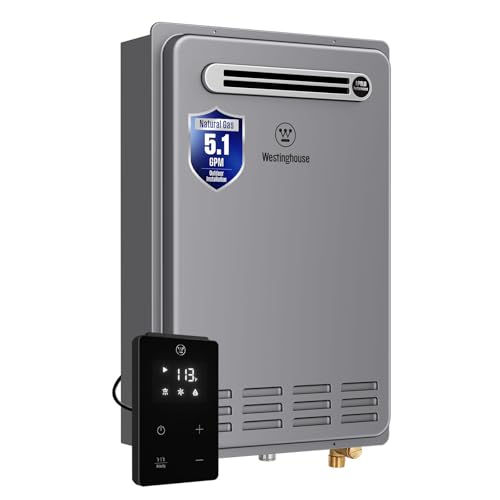
- 5.1 GPM and 120,000 BTU output
- Designed for 2–4 fixtures
- Anti-freezing outdoor design
Best For: Moderate-demand natural gas homes
Best RV Freeze-Protected Pick
CAMPLUX 2.64 GPM RV Tankless Heater

- Freeze protection below 43°F for cold-weather RV trips
- 65,000 BTU propane burner with up to 2.64 GPM listed flow
- CSA/NSF certified with wired temperature-control remote
Best For: Four-season RV travel and tank-heater replacement
Best Indoor Multi-Point Value
4.3 GPM Propane Tankless Heater

- 100,000 BTU output and up to 4.3 GPM flow
- Freeze, overheat, dry-fire, and flame-failure protection
- LED touchscreen with 95°F–149°F temperature range
Best For: Indoor homes serving two to four water points
Best Winter Protection System
Riwory 4.3 GPM Tankless Heater

- Four 25-watt modules activate below 39°F
- 102,000 BTU output and up to 4.3 GPM flow
- Specified ±1°F temperature stability with multiple safeguards
Best For: Cold-climate homes serving three to four water points
Compact RV Freeze Guard – Suburban ST-42 42,000 BTU
For RV owners comparing tankless water heaters with freeze protection, the Suburban ST-42 combines on-demand propane heating with active freeze and voltage protection. Its digital controls and safety features make it a practical choice for mobile use, provided power and propane are available during freezing conditions.
Best For: RV owners who want endless hot water, digital controls, and built-in cold-weather safeguards.
Pros:
- Active freeze protection helps prevent freeze damage when power and propane are available.
- Flame-out, scald, and voltage protection add multiple safety measures.
- Child lock limits outlet temperature to 113°F, while the internal kill switch caps water temperature at 131°F.
- Included wall-mount digital control center supports convenient operation.
Cons:
- Requires a separately sold 6285APW or 6285AEB door for installation.
- Freeze protection depends on available power and propane.
The ST-42 is a well-equipped RV option for buyers prioritizing freeze protection and safety controls. Confirm the required door and installation compatibility before purchasing.
Smart Point-of-Use Pick – Westinghouse 11kW Electric
The Westinghouse 11kW is an electric point-of-use heater for shoppers considering tankless water heaters with freeze protection, though the supplied specifications emphasize electrical, overheat, dry-fire, and leakage protection rather than a dedicated freeze-guard function. Its Wi-Fi controls, compact design, and 2.6 GPM maximum flow make it suited to a single water outlet.
Best For: Smart-home users needing compact electric hot water for one point of use.
Pros:
- Heats water in about 3 seconds and reaches up to 2.6 GPM under stated conditions.
- Wi-Fi, Alexa, and Google Home compatibility enables remote temperature control.
- ETL certification includes leakage, overheat, dry-fire, and over-voltage protection.
- Removable inlet filter and rotor simplify periodic cleaning.
Cons:
- Requires a dedicated 60A double-pole breaker and 8 AWG wire at 240V.
- Designed for one point of use rather than broad simultaneous demand.
- The supplied notes do not specify dedicated freeze protection.
This is a strong compact smart-electric choice, but it should not be treated as a dedicated freeze-protection model without confirming installation requirements and cold-weather needs.
High-Output RV Freeze Guard – Suburban ST-60 60,000 BTU
Among tankless water heaters with freeze protection, the Suburban ST-60 stands out for its 60,000 BTU output and RV-focused design. It provides on-demand propane hot water with active freeze protection, voltage protection, digital controls, and several safeguards for family use.
Best For: RV owners who want higher-output tankless hot water with built-in freeze and voltage protection.
Pros:
- 60,000 BTU heat output supports robust RV hot-water demand.
- Active freeze protection operates when power and propane are available.
- Flame-out, scald, child-lock, and voltage protection improve operating safety.
- Wall-mounted design, digital controls, and a two-year limited warranty add convenience.
Cons:
- Requires a separately sold 6285APW or 6285AEB door.
- Freeze protection depends on continued power and propane availability.
- Its RV-specific design may not suit standard residential installations.
The ST-60 is the stronger Suburban choice when higher BTU output matters. Verify space, door compatibility, and fuel and electrical availability before installation.
Whole-House Electric Alternative – CAMPLUX 18kW Electric
The CAMPLUX 18kW is a whole-house electric tankless heater with fast activation, high stated efficiency, and multi-point capability. It is worth considering alongside tankless water heaters with freeze protection, but the supplied information lists temperature, overheat, anti-dry-heating, and water-electricity separation protections rather than a dedicated freeze-guard feature.
Best For: Homes wanting compact 240V electric tankless heating for multiple water points.
Pros:
- 18kW output supports multi-point whole-house use.
- Heats water in more than 3 seconds with stated efficiency up to 99.8%.
- Includes overheat, anti-dry-heating, and water-electricity separation protection.
- Digital display, wall-mount design, and included installation hardware simplify use.
Cons:
- Requires 240V hardwiring, two double-pole 40A breakers, and 2 x 8 AWG wiring.
- Needs at least 0.66 GPM to activate.
- The supplied notes do not specify dedicated freeze protection.
The CAMPLUX offers strong electric capacity for a whole-house setup, but buyers in freezing climates should confirm whether their planned installation needs separate freeze protection.
Best Whole-Home Propane Pick – 8.1 GPM Outdoor Tankless Heater
If you need tankless water heaters with freeze protection for a larger home, this outdoor propane model combines 8.1 GPM of flow with 180,000 BTU of heating power. It is designed to support three to five fixtures at once while maintaining outlet temperature within ±1°F.
Best For: Larger households needing whole-home hot water from an outdoor propane installation.
Pros:
- Supports three to five fixtures simultaneously at up to 8.1 GPM.
- Integrated anti-freeze protection and CSA certification support outdoor use.
- Includes a wired controller and adjustable 95°F–158°F temperature range.
- Backed by a two-year unit warranty and five-year heat-exchanger warranty.
Cons:
- Requires propane, 120V AC power, and 3/4-inch NPT plumbing.
- Outdoor installation and gas connections may require professional setup.
With high flow capacity, precise temperature control, and integrated freeze protection, this Westinghouse model is a strong choice when you want one outdoor heater for several simultaneous household demands.
Best Point-of-Use Electric Pick – Compact 6kW Under-Sink Heater
For a compact point-of-use option among tankless water heaters with freeze protection, this 6kW electric unit is designed for sinks, apartments, offices, and small households. Its self-modulating system adjusts power based on flow, with a temperature display for convenient control.
Best For: Small spaces that need instant hot water at a sink or other single point of use.
Pros:
- Compact wall-mounted design measures about 10.95 by 7.4 by 2.52 inches.
- Self-modulating power helps match energy use to water demand.
- Touch control displays water temperature and inlet flow.
- Includes overheat protection and a cast aluminum heating element.
Cons:
- Requires hardwiring to a 240V, 30A circuit with 10AWG wire.
- Its 1.5 GPM flow rate is intended for point-of-use applications rather than whole-home demand.
- The supplied notes do not specify an integrated freeze-protection feature.
This CAMPLUX heater makes sense where installation space is limited and a dedicated sink supply is the priority, but its electrical requirements and point-of-use capacity should be checked before purchase.
Best Natural Gas Value – 5.1 GPM Outdoor Tankless Heater
This natural gas model is a practical choice for buyers comparing tankless water heaters with freeze protection for everyday whole-home use. Its 5.1 GPM flow and 120,000 BTU output are sized for two to four fixtures, while self-modulation helps keep temperature within ±1°F.
Best For: Homes with natural gas service that typically run two to four hot-water fixtures at once.
Pros:
- Provides up to 5.1 GPM for showers, sinks, dishwashers, and laundry appliances.
- Integrated freeze protection, a variable-speed combustion fan, and CSA certification support outdoor operation.
- Self-modulating controls help maintain temperature within ±1°F.
- Wall-mounted design saves indoor space and includes a wired control panel.
Cons:
- Requires natural gas, 120V AC power, and 3/4-inch NPT plumbing.
- Below 5°F or during extended non-use, the manufacturer recommends fully draining the system.
- Its two-to-four-fixture capacity is lower than the larger 8.1 GPM model.
For a moderate-demand household, this Westinghouse heater offers a balanced combination of natural-gas efficiency, outdoor installation, temperature stability, and freeze-protection features.
Best RV Freeze-Protected Pick – CAMPLUX 2.64 GPM RV Tankless Heater
For RV owners seeking tankless water heaters with freeze protection, the CAMPLUX combines propane-powered on-demand heating with cold-weather features. Its 65,000 BTU burner delivers up to 2.64 GPM in the listed operating specification, while the built-in freeze protection activates below 43°F.
Best For: RVs, campers, motorhomes, fifth wheels, and four-season travel.
Pros:
- Freeze protection and a copper heat exchanger support cold-weather RV use.
- CSA and NSF certified, with flame-failure, overheat, and pressure-relief protection.
- Wired remote offers 95°F–124°F temperature adjustment in 1°F increments.
- Designed as an upgrade for many Suburban and Atwood tank heaters.
Cons:
- It is designed for RV installations rather than typical residential plumbing.
- Propane and 12-volt DC power are required.
- The listed maximum temperature is 124°F.
The CAMPLUX is a practical choice when mobile installation, altitude capability, and winter protection matter more than residential-scale flow. Its certifications and included wired controller add convenience for RV use.
Best Indoor Multi-Point Value – 4.3 GPM Propane Tankless Heater
This indoor propane model is among the tankless water heaters with freeze protection aimed at serving several household fixtures. Its 100,000 BTU system provides up to 4.3 GPM, and the LED touchscreen makes temperature adjustments straightforward.
Best For: Indoor use with two to four points of use, such as a shower, kitchen faucet, and bathroom sink.
Pros:
- Up to 4.3 GPM and 100,000 BTU capacity support simultaneous fixture use.
- Anti-freezing, dry-fire, flame-failure, overheat, and gas-leak protections are listed.
- Temperature adjusts from 95°F to 149°F with stated ±1°F control.
- Wall-mounted design includes a vent pipe and LED touchscreen.
Cons:
- Professional installation by a licensed technician is required.
- Performance is recommended below 2,000 feet altitude.
- It requires 120V AC power and 1/2-inch NPT connections.
Choose this unit if you want a compact indoor heater with broad temperature control and enough stated capacity for multiple fixtures. Confirm venting, gas pressure, electrical supply, and professional installation requirements before buying.
Best Winter Protection System – Riwory 4.3 GPM Tankless Heater
The Riwory is a strong contender among tankless water heaters with freeze protection for indoor residential use. It combines 102,000 BTU output and up to 4.3 GPM flow with four 25-watt heating modules that activate below 39°F to help protect the heat exchanger from freezing.
Best For: Residences needing hot water for three to four points of use in colder climates.
Pros:
- Four-stage combustion is designed to provide efficient seasonal temperature control.
- Automatic anti-freeze modules activate below 39°F (4°C).
- Intelligent temperature control is specified to hold water within ±1°F.
- Multiple protections include over-temperature, dry-combustion, pressure, flame, and anti-scald safeguards.
Cons:
- The unit requires 120V AC power for operation and freeze protection.
- Its freeze-protection threshold is below 39°F, so installation conditions still matter.
- Professional evaluation may be needed to confirm compatibility with the specified 3/4-inch connections and venting.
Riwory stands out for its dedicated winter-protection hardware and broad safety package. It is worth considering for a cold-climate home, provided the installation meets its gas, water, electrical, and venting specifications.
How We Picked the Best Tankless Water Heaters with Freeze Protection
We selected models across the main use cases represented in this category: RV replacement, point-of-use installation, and whole-house hot water. Our comparison considers heating capacity, flow rate, fuel type, installation setting, temperature control, certifications, and stated freeze-protection features. Because freeze protection does not make every installation winterproof, we also considered whether a unit is intended for indoor or outdoor use and whether its design suits seasonal or full-time occupancy.
Specifications can vary with incoming-water temperature, gas pressure, electrical service, altitude, and the number of fixtures operating at once. Treat advertised flow rates as best-case figures rather than guaranteed performance.
Quick Comparison
- RV-focused: Suburban ST-42, Suburban ST-60, and the CAMPLUX 65,000-BTU propane model are designed for recreational vehicles and compact mobile installations.
- Point of use: The Westinghouse 11kW and CAMPLUX 6kW electric units suit a single sink, shower, or remote fixture where a full-house system is unnecessary.
- Electric whole-house options: The CAMPLUX 18kW model can serve larger demand, but it requires substantial 240-volt electrical capacity.
- Whole-house gas: The Westinghouse propane and natural-gas models, along with the 100,000- and 102,000-BTU propane units, are intended for higher flow and multiple fixtures.
Key Buying Factors for Tankless Water Heaters with Freeze Protection
Fuel and Available Utility Capacity
Electric models are generally compact and avoid combustion venting, but high-output units may require dedicated 240-volt circuits and significant amperage. Propane and natural-gas heaters can deliver stronger flow for whole-house use, yet they require appropriate gas lines, venting, clearances, and professional installation where required.
Flow Rate and Temperature Rise
Look beyond the maximum GPM. A heater’s usable output depends on how cold the incoming water is and how much temperature increase you need. A small point-of-use unit may be ideal for one fixture, while a multi-bathroom home may need a higher-BTU model or staged demand management.
What Freeze Protection Actually Covers
Built-in freeze protection typically uses electricity, heating elements, or controlled operation to help protect the heat exchanger and water passages. It may not function during a power outage, disconnected fuel supply, improper winterization, or extreme temperatures. Outdoor and RV installations may also need insulated plumbing, drained lines, heat tracing, or a backup power source.
Controls, Certifications, and Installation
Digital displays, remote controls, Wi-Fi, and precise temperature adjustment can improve convenience, but they do not replace correct sizing. Check CSA, ETL, NSF, or other applicable certifications, confirm venting and clearance requirements, and verify that local codes permit the installation location.
Who Should Buy Which Tankless Water Heaters with Freeze Protection?
RV owners should prioritize compact dimensions, 12-volt compatibility where applicable, service access, altitude performance, and reliable winterization procedures. Apartment, cabin, and single-fixture users may prefer an electric point-of-use model for simpler installation and lower upfront capacity.
Small homes with moderate demand can consider a mid-output electric or gas unit after confirming utility capacity. Larger households should focus on higher-BTU gas models, available flow at their winter water temperature, and professional sizing. For any outdoor installation in a freezing climate, choose a unit with documented freeze protection and plan for power-loss and shutdown scenarios rather than relying on the feature alone.