Tankless water heaters with thermostat controls can deliver hot water on demand while helping you set a more consistent outlet temperature. The right model depends on flow rate, electrical capacity, installation location, and whether you need point-of-use or whole-home heating.
We compared 10 notable options across electric and propane designs, focusing on temperature control, power requirements, installation flexibility, efficiency, and practical household use.
Best 10 Tankless Water Heaters with Thermostat Picks for 2026
Best Compact Point-of-Use Pick

- Thermostatic control within 1 degree
- Compact wall-mounted design
- Up to 1.5 GPM flow
Best For: Small point-of-use installations
Best Spa Heating Specialist
- Digital thermostat control
- 99.8% stated efficiency
- 10 GPM activation flow
Best For: Spa heater replacement projects
Best 120V Sink Option

- LED digital temperature display
- Self-modulating power control
- Low 0.26 GPM activation flow
Best For: One-sink point-of-use installations
Best Multi-Fixture Rheem Option
- 1-degree digital thermostatic control
- Up to 1.95 GPM flow
- 5-year leak warranty
Best For: Moderate multi-fixture demand
Best Compact Sink Heater
- 1.07 GPM at a 35°F rise
- 1°F digital temperature adjustment
- Compact, self-modulating design
Best For: Localized hot water under or over a sink
Best Whole-Home Capacity
- Up to 4.4 GPM flow rate
- External digital thermostatic control
- Self-modulating 18kW output
Best For: Higher-demand residential electric water heating
Best High-Capacity Pick
ORBEK 14kW Electric Tankless Heater

- Up to 3.38 GPM for two to three points of use
- 86°F–140°F digital temperature setting
- Requires 240V, 60A service and 6 AWG wiring
Best For: Higher-demand electric use where the home has sufficient electrical capacity
Best RV Retrofit
Furrion 2.4 GPM Propane Tankless Heater

- Included wall thermostat for temperature control
- 2.4 GPM output with 60,000 BTU heating
- Designed to retrofit compatible RV tank heaters
Best For: RV owners seeking propane-powered on-demand hot water
Best Point-of-Use Value
110V Under-Sink Electric Heater

- Digital LED control with Fahrenheit/Celsius settings
- Compact 110V design for sink-side installation
- Not designed for shower-level flow rates
Best For: Sinks and small point-of-use hot-water applications
Best Compact Point-of-Use Pick – Rheem RTEX-06T
The Rheem RTEX-06T is a practical choice when you want tankless water heaters with thermostat control for a single point of use. Its 6.5kW, 240V design continuously monitors water temperature, adjusts flow, and fits in a compact wall-mounted space.
Best For: Sinks, small point-of-use installations, and buyers prioritizing compact size and steady temperature control.
Pros:
- Thermostatic control helps maintain the selected temperature within 1 degree.
- Compact wall-mounted design is 90% smaller than traditional tank heaters.
- Heats water only when it is being used, reducing standby energy use.
- Provides up to 1.5 GPM flow and a maximum temperature of 140°F.
Cons:
- The 1.5 GPM flow rate is better suited to point-of-use applications than multiple fixtures.
- Requires a 240V electrical connection.
With its small footprint and precise thermostatic operation, the RTEX-06T is a focused solution for localized hot-water demand. Confirm the electrical setup and expected flow before installation.
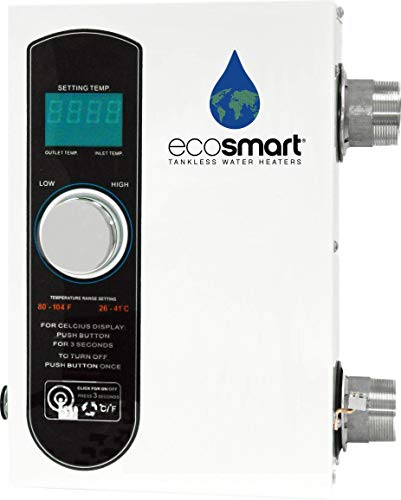
Best Spa Heating Specialist – EcoSmart Smart 11 Spa Heater
The EcoSmart Smart 11 is designed specifically for spa heating, making it a specialized option among tankless water heaters with thermostat control. It combines digital thermostat control, flow-sensor technology, and 12,000 watts of heating power.
Best For: Replacing an existing spa heater where digital temperature control and high flow activation are appropriate.
Pros:
- Digital thermostat control makes temperature adjustments convenient.
- Flow sensor technology supports on-demand operation.
- Rated at 99.8% efficiency.
- Compact 12-by-10.5-by-4.75-inch design can replace an existing spa heater.
Cons:
- Its 10 GPM activation flow is intended for spa applications rather than typical sink use.
- Designed as a floor-mount unit, which may offer less installation flexibility than wall-mounted models.
- The warranty excludes heating elements and does not cover labor or incidental costs.
The Smart 11 makes the most sense when the project is a spa-heater replacement, not a general household point-of-use installation. Verify compatibility, voltage, and flow requirements before buying.
Best 120V Sink Option – CAMPLUX 4.5kW Tankless Heater
The CAMPLUX TE05N4 offers thermostat-style digital temperature adjustment in a compact 120V format. For shoppers comparing tankless water heaters with thermostat controls, it adds an LED display, self-modulating power, and a low 0.26 GPM activation threshold for one sink.
Best For: A single sink in a kitchen, wet bar, boat, or other compact location with a suitable hard-wired 120V circuit.
Pros:
- Touch controls and an LED display make the temperature easy to set and monitor.
- Self-modulating operation adjusts power according to flow and temperature settings.
- Compact wall-mounted body measures 10.95 by 2.52 by 7.4 inches.
- Activates at a low 0.26 GPM flow rate and reaches up to 131°F.
Cons:
- Designed for only one sink at a time.
- Must be hard-wired and requires a 40A circuit breaker with 10AWG wire.
- Its 4.5kW output may be limited for higher-flow applications.
This CAMPLUX model is convenient when a compact sink heater and 120V service are priorities. Its electrical requirements should be confirmed by a qualified installer before purchase.
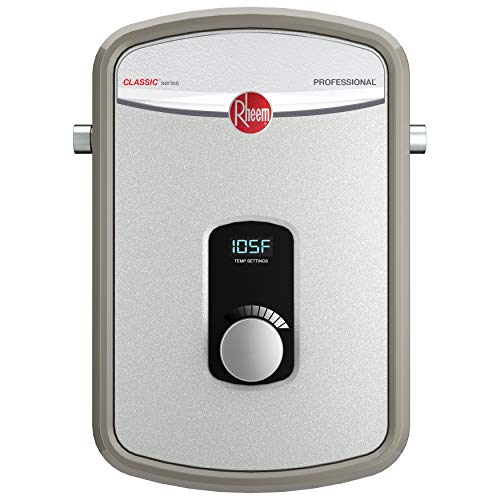
Best Multi-Fixture Rheem Option – Rheem RTEX-08 8kW
The Rheem RTEX-08 is a 240V, 8kW model built for multi-fixture point-of-use applications. Its digital thermostatic controls adjust in 1-degree increments from 80°F to 140°F, making it a strong contender among tankless water heaters with thermostat control.
Best For: Multi-fixture installations where up to 1.95 GPM flow and precise digital temperature adjustment are sufficient.
Pros:
- Digital thermostatic control adjusts temperature in 1-degree increments.
- Provides up to 1.95 GPM for multiple-fixture applications.
- Compact design is 90% smaller than traditional tank water heaters.
- Includes a 5-year leak warranty and 1-year parts warranty.
Cons:
- Requires 240V single-phase power, a 40A double-pole breaker, and #8 AWG copper conductors.
- The recommended minimum household service panel is 100A.
- Its capacity may not meet higher-demand whole-home applications.
The RTEX-08 balances compact installation with more flow than a basic sink-only unit. Carefully verify household electrical capacity and expected simultaneous demand before installation.
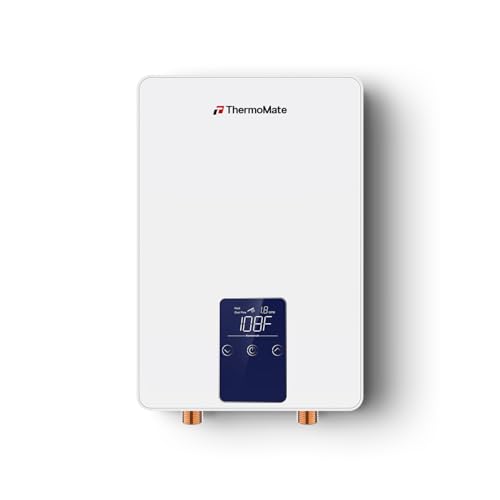
Best Compact Sink Heater – ThermoMate 6kW Point-of-Use
For shoppers comparing tankless water heaters with thermostat controls, the ThermoMate 6kW is a compact point-of-use option for delivering adjustable hot water at a sink. Its digital display and touch controls allow temperature changes in 1°F increments, while self-modulation helps limit energy use during operation.
Best For: Under-sink or over-sink installations in kitchens, bathrooms, salons, bar counters, and other locations needing localized hot water.
Pros:
- Digital temperature display with 1°F adjustment increments and an 85°F–131°F range
- Self-modulating operation with listed 99.8% efficiency
- Compact 2.52-inch-deep design with separated heating element and water line
- Provides up to 1.07 GPM at a 35°F temperature rise
Cons:
- Requires 240V hardwiring, a 30A circuit breaker, and minimum 10AWG wiring
- Its point-of-use flow rate is not intended for whole-home demand
- Requires compatible 1/2-inch NPT water connections
This ThermoMate is a practical choice when precise thermostat-style adjustment and a small footprint matter most. Confirm the electrical requirements and expected flow before installation.
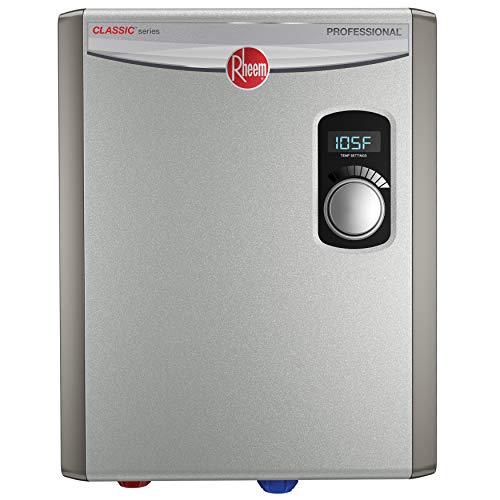
Best Whole-Home Capacity – Rheem 18kW Electric
The Rheem RTEX-18 is a higher-capacity option among tankless water heaters with thermostat controls, offering external digital control and an LED display with approximately 1-degree accuracy. Its self-modulating system adjusts power according to hot-water demand, with a listed flow rate of up to 4.4 GPM.
Best For: Homes needing a wall-mounted electric tankless heater with substantially more flow capacity than a small point-of-use unit.
Pros:
- External digital thermostatic control with LED display and approximately 1-degree accuracy
- Self-modulation adjusts power to match hot-water demand
- Up to 4.4 GPM flow rate and 18kW heating output
- Copper immersion heating elements are field serviceable
Cons:
- Requires a 240V AC electrical supply
- Flow performance depends on incoming water temperature and demand
- Installation uses bottom 3/4-inch NPT water connections
With its external thermostat control, higher output, and serviceable heating elements, the Rheem is the strongest fit of these options for broader household demand. Review electrical capacity and installation requirements before choosing it for a whole-home setup.
Best 120V Point-of-Use Pick – ThermoMate 4.5kW Under-Sink
The ThermoMate 4.5kW is designed for shoppers seeking tankless water heaters with thermostat controls in a compact under-sink format. Its touch panel and digital display support 1°F adjustments from 85°F to 131°F, while self-modulation varies power as water is needed.
Best For: Point-of-use hot water at a sink where a compact 110–120V unit and adjustable digital temperature control are priorities.
Pros:
- Digital temperature display with 1°F adjustment increments
- Self-modulating operation with listed 99.8% efficiency
- Compact, 2.52-inch-deep housing suited to tight spaces
- Separated cast-aluminum heating element and stainless steel water tube
Cons:
- Designed for point-of-use applications rather than whole-home heating
- Requires hardwiring with a 40A double-pole circuit breaker and minimum 8AWG wire
- Uses 1/2-inch NPT water connections
This model offers convenient digital temperature control in a small package, but its installation requirements are substantial for a 110–120V point-of-use heater. Verify the circuit, wiring, connections, and expected flow before purchase.
Best High-Capacity Pick – ORBEK 14kW Electric Tankless Heater
For shoppers comparing tankless water heaters with thermostat-style temperature control, the ORBEK 14kW is built for whole-home-style electric use where the electrical service can support its demanding installation requirements. It offers digital temperature adjustment, rapid heating, and a claimed flow rate of up to 3.38 GPM.
Best For: Homes needing electric on-demand hot water for two to three points of use, such as a bathroom and kitchen.
Pros:
- Digital control lets you set temperatures from 86°F to 140°F, with temperature stability within ±1°F according to the manufacturer.
- Provides up to 3.38 GPM and claims hot water in about three seconds.
- ETL certified with leakage, over-temperature, dry-heating, and other listed protection systems.
- Compact wall-mounted design measures 14.2 by 9.5 by 3.1 inches.
Cons:
- Requires a 240V/60A two-pole breaker, 6 AWG wiring, and a household panel with at least 150A total capacity.
- Hard-wiring and 1/2-inch NPT water connections may require professional installation.
This is a strong option when precise electronic temperature control and higher flow matter more than simple installation. Confirm electrical capacity before purchase, since the installation requirements are substantial.
Best RV Retrofit – Furrion 2.4 GPM Propane Tankless Heater
Among tankless water heaters with thermostat controls, the Furrion stands out as an RV-focused propane model with an included wall thermostat. Its 60,000 BTU burner and 2.4 GPM output are designed to replace a limited-capacity tank heater while maintaining a consistent water temperature.
Best For: RV owners upgrading a compatible tank water heater to propane-powered tankless operation.
Pros:
- Included wall thermostat displays and adjusts water temperature, time, and pressure level.
- Delivers up to 2.4 gallons per minute with a 60,000 BTU heat output.
- Vortex technology premixes water to help reduce cold spots and scalding.
- Includes pressure relief, over-temperature, blower block, and automatic shutoff protections.
Cons:
- Designed for RV retrofit applications rather than general residential installation.
- Requires propane and electric ignition, so it is not a fully electric water-heating solution.
For an RV upgrade, the wall thermostat and retrofit-oriented design make this a practical choice. Verify that the dimensions and existing installation are compatible before replacing your current unit.
Best Point-of-Use Value – 110V Under-Sink Electric Heater
This compact 110V model is a practical entry in tankless water heaters with thermostat-style digital control for sinks and other point-of-use applications. Its LED display, adjustable Fahrenheit or Celsius settings, and 3,000W heating system make it suited to smaller hot-water demands rather than showers.
Best For: Kitchen sinks, bathroom sinks, apartments, RVs, and other locations needing localized hot water.
Pros:
- LED display supports temperature monitoring and Fahrenheit/Celsius selection.
- Compact wall-mounted design uses a standard 110V power supply and 1/2-inch NPT connections.
- Includes leakage, dry-boil, overheating, inactivity, and water-electricity isolation protections.
- Manufacturer lists up to 98% thermal efficiency and a 24-month warranty.
Cons:
- Not suitable for showers; the supplied guidance says showers normally require at least 1.8 GPM.
- Must be installed vertically and requires wiring connected to a trip switch over 32A.
- Its output is intended for point-of-use demands, not multiple high-flow fixtures.
This heater makes the most sense when you want hot water close to a sink without reserving space for a tank. Keep expectations aligned with its limited flow and follow the vertical-installation and wiring instructions carefully.
How We Picked the Best Tankless Water Heaters with Thermostat
We evaluated these Tankless Water Heaters with Thermostat features by comparing their heating capacity, voltage, stated flow rate, control design, installation format, and intended use. Point-of-use models were assessed for sinks, small bathrooms, spas, and other single-fixture applications, while larger units were considered for multi-fixture or whole-home demand.
We also considered practical installation requirements, including hardwiring, circuit capacity, fuel type, ventilation, water connections, and access to service controls. Product listings can vary by seller, so confirm the installation manual and current specifications before purchase.
Quick Comparison
| Best For | Typical Choice | What to Check |
|---|---|---|
| Single sink or remote fixture | 4.5kW–6.5kW electric unit | Voltage, amperage, and flow rate |
| Multiple fixtures | 8kW–18kW electric unit | Incoming water temperature and service-panel capacity |
| RV or propane installation | Gas model with thermostat | Ventilation, propane supply, and freeze protection |
| Under-sink installation | 110V–120V compact heater | Outlet requirements and realistic flow |
Key Buying Factors for Tankless Water Heaters with Thermostat
Heating Power and Flow Rate
Wattage determines how quickly an electric unit can raise water temperature. A compact 110V or 120V model is generally suited to one low-flow fixture, while 240V heaters with higher wattage can support greater demand. Flow rate still depends on incoming water temperature and the temperature rise you need, so advertised gallons-per-minute figures are not universal.
Electrical or Fuel Requirements
Check the required voltage, amperage, breaker size, and whether the heater must be hardwired. Higher-output electric models may require dedicated circuits or electrical-service upgrades. Propane units need proper gas connections, ventilation, ignition power, and freeze-protection planning.
Temperature Control and Safety
A digital thermostat or precise temperature display makes it easier to set comfortable water temperatures and reduce scald risk. Look for adjustable controls, over-temperature protection, flow activation, and clear status indicators. Always follow the manufacturer’s temperature and installation guidance.
Installation Location and Maintenance
Measure the available wall or cabinet space and confirm water-connection orientation before buying. Tankless heaters benefit from clean inlet water; a sediment filter or scale-control strategy may be useful in hard-water areas. Ensure the unit remains accessible for cleaning and servicing.
Who Should Buy Which Tankless Water Heaters with Thermostat?
Choose a compact 110V–120V heater for a single sink, remote wash station, or light point-of-use application where upgrading the electrical system is undesirable. A 4.5kW–6.5kW 240V model is a better fit for a dedicated sink or small bathroom when a stronger circuit is available.
For multiple fixtures, consider an 8kW–18kW electric model, but verify that its output matches your climate, incoming water temperature, and simultaneous demand. If you need a spa-focused heater, prioritize the flow and temperature range required by the equipment rather than choosing by wattage alone.
A propane tankless unit may suit RVs, cabins, or locations without sufficient electric capacity, provided installation meets fuel, ventilation, and local safety requirements. Whatever you choose, size the heater around actual flow and temperature rise—not just the product’s maximum rating.