Finding a refrigerant leak quickly can reduce callback risk, protect equipment, and help technicians avoid unnecessary disassembly. Ultrasonic detection is especially useful when a system is pressurized and the leak produces an audible high-frequency signal.
This roundup compares 10 ultrasonic refrigerant leak detectors, from compact basic kits to professional models with touch probes, goosenecks, carrying cases, and accessory bundles. Use the guide below to match detection features and included equipment to your workload.
Best 10 Ultrasonic Refrigerant Leak Detectors Picks for 2026
Best Basic Kit

- Natural-sound audio conversion
- 10-element visual bar graph
- Headset, battery, and hard case included
Best For: Straightforward ultrasonic leak checking
Best Versatile Automotive Tool
allsun Pro Ultrasonic Detector
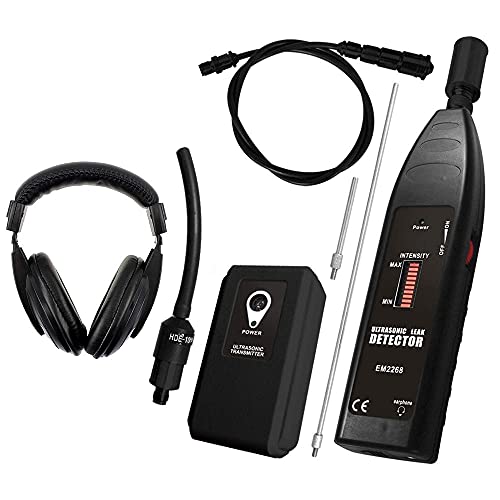
- 36–44 kHz ultrasonic detection
- Contact probe for mechanical sounds
- Adjustable volume and LED indicators
Best For: Automotive and industrial diagnostics
Best for Noisy Worksites

- Detects pressure and vacuum leaks
- Headphones work in noisy environments
- Laser pointer aids pinpointing
Best For: Industrial pressure and vacuum inspections
Best Professional Kit
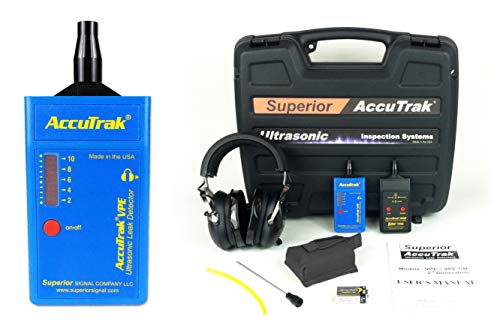
- Natural-sound audio conversion
- Touch probe and waveguide included
- Noise-blocking headphones and large case
Best For: Detailed professional leak investigation
Versatile Handheld Pick

- 20–90 kHz operating range
- Three noise filters
- Includes probe accessories and case
Best For: Portable industrial and construction-site leak scanning
Professional Multi-Use Choice

- Handles pressure and vacuum leaks
- Laser pointer aids pinpointing
- Includes transmitter, probes, and rugged case
Best For: Professional multi-application inspection work
Visual Automotive Imaging Option
FOTRIC Manisen TD2e Acoustic Camera

- Live color soundmap on LCD
- 2–100 kHz detection range
- Covers A/C, EVAP, brakes, and EV seals
Best For: Automotive shops needing visual, non-contact leak localization
Professional Gooseneck Kit

- Adjustable sensitivity with peak-hold display
- Includes probes, sound generator, and noise-canceling headphones
- Designed for hard-to-reach leaks and varied environments
Best For: Professional technicians needing a versatile, fully equipped inspection kit
Portable Multi-System Scanner
38-42kHz Ultrasonic Leak Detector

- Detects air, gas, and water leaks
- Adjustable sensitivity with sound and light alerts
- Includes headset, case, and 9V battery
Best For: Portable HVAC, automotive, and industrial troubleshooting
Simple Refrigerant Leak Finder

- Detects leaks equivalent to 1.5 oz/year of refrigerant
- 10-element visual bar graph with audio output
- Adjustable sensitivity in a compact battery-powered design
Best For: Routine HVAC leak checks with visual and audio feedback
Best Basic Kit – AccuTrak VPE BASIC
The Superior AccuTrak VPE BASIC is a straightforward choice for buyers comparing ultrasonic refrigerant leak detectors. Its natural-sound audio conversion lets you hear leak signals, while the 10-element bar graph adds a quick visual indication.
Best For: Users who want a compact basic kit for general ultrasonic leak checking.
Pros:
- Audio output from 0 Hz to 4 kHz supports natural-sound listening.
- 10-element bar graph provides visual leak indication.
- Includes the detector, headset, battery, and hard case.
Cons:
- The basic kit does not list the expanded probe and headphone accessories included with the PRO kit.
- Supplied notes provide limited detail about specific applications.
This is a sensible entry-level option when you value simple audio and visual feedback plus a protective case, without needing the more extensive accessories of a professional kit.
Best Versatile Automotive Tool – allsun Pro Ultrasonic Detector
The allsun Pro is a versatile option among ultrasonic refrigerant leak detectors, with a 36–44 kHz detection range for escaping air, gas, and vacuum leaks. Adjustable volume, LED intensity indicators, and multiple accessories help users investigate both leaks and mechanical sounds.
Best For: Automotive and industrial users checking air-conditioning, gas, vacuum, and air-brake systems.
Pros:
- Designed to detect high-frequency sounds from air, gas, and vacuum leaks.
- Includes a contact probe for bearings, valves, and pump diagnostics.
- Adjustable volume, LED indicators, focusing cone, and headset support practical troubleshooting.
Cons:
- Not designed for water pipes, plumbing, swimming pools, or tires.
- Requires two 9V batteries.
- Supplied notes recommend testing it with the included test leak before use.
This kit stands out for its broad automotive and industrial scope. It is a better fit for mechanical troubleshooting than for household plumbing or tire-leak work.
Best for Noisy Worksites – INFICON Whisper
The INFICON Whisper is built for pressure and vacuum leak detection across a range of gases, making it a strong contender among ultrasonic refrigerant leak detectors. Included headphones, a laser pointer, and operation in noisy environments support more focused inspection work.
Best For: Technicians locating pressure or vacuum leaks in noisy industrial environments.
Pros:
- Detects pressure and vacuum leaks for all gases, including pressurized nitrogen leaks.
- Headphones help users hear leak signals in noisy environments.
- Laser pointer helps pinpoint the leak location.
- Includes a rubber extension probe, two D-cell alkaline batteries, and a rugged carrying case.
Cons:
- Uses two D-cell alkaline batteries.
- The supplied dimensions and 3-pound weight may be less convenient for highly portable use.
With its laser-assisted pinpointing, headphones, and rugged case, the Whisper is a practical choice for professional inspections where ambient noise and varied gas systems are concerns.
Best Professional Kit – AccuTrak VPE PRO
The Superior AccuTrak VPE PRO expands on the basic detector with accessories aimed at professional inspection work. Its 0 Hz to 4 kHz natural-sound conversion and 10-element bar graph provide both audible and visual feedback when comparing ultrasonic refrigerant leak detectors.
Best For: Professionals who need a fuller AccuTrak kit for detailed leak investigation.
Pros:
- Natural-sound audio conversion makes leak signals easier to hear and distinguish.
- 10-element bar graph provides a quick visual indication.
- Includes a touch probe, waveguide, and noise-blocking headphones.
- Large carry case and battery support field use.
Cons:
- At 5.3 pounds, it is heavier than a minimal detector setup.
- Its larger accessory kit may be more than casual users need.
The VPE PRO is the stronger pick for buyers who want specialized probing and noise-blocking headphones included from the start. It offers more inspection flexibility than the BASIC kit, at the cost of added size and weight.
Versatile Handheld Pick – Amprobe ULD-410
The Amprobe ULD-410 is a practical choice among ultrasonic refrigerant leak detectors for technicians who need adjustable sensitivity in varied work environments. Its 20 kHz to 90 kHz operating range, three noise filters, and LCD bargraph help with both locating and confirming suspected leaks.
Best For: Industrial maintenance and construction-site scanning where portability and noise reduction matter.
Pros:
- Broad 20 kHz to 90 kHz frequency range for different leakage events
- Three filters help reduce common background noise
- Includes headphones, earbuds, a power parabola, tubing adapter, and carrying case
- Approximately 105-hour battery life
Cons:
- No manufacturer warranty is listed
- The LCD bargraph provides less visual detail than an acoustic imaging camera
The ULD-410 is a sensible all-around handheld detector for users who prefer headphone-based leak localization and straightforward controls. Its included accessories make it ready for several inspection approaches out of the box.
Professional Multi-Use Choice – INFICON Whisper Leak Detector
INFICON Whisper with Accessory Kit, Enhanced Ultrasonic Leak Detector, 711-203-G1,Off-White
Check Price On AmazonThe INFICON Whisper is a versatile option for ultrasonic refrigerant leak detectors, especially when one tool must handle pressure and vacuum leaks across different systems. It works in noisy environments, supports headphone-based listening, and includes a transmitter for applications where an ultrasonic signal needs to be introduced.
Best For: Professional technicians checking pressure or vacuum leaks, electrical arcing, steam traps, and pressurized nitrogen systems.
Pros:
- Detects pressure and vacuum leaks for all gases
- Laser pointer helps pinpoint the suspected leak location
- Includes premium headphones, metal contact probe, rubber extension probe, transmitter, batteries, and rugged case
- IP44-rated housing and approximately 115,165-hour battery-life specification
Cons:
- Runs on two D-cell alkaline batteries, adding bulk compared with smaller battery formats
- The listed operating frequency is 40.5 kHz rather than a broad adjustable range
With its transmitter, contact probes, laser pointer, and broad application list, the Whisper is built for more than basic HVAC checks. It is a strong fit for service teams that want a dedicated, multi-purpose ultrasonic inspection kit.
Visual Automotive Imaging Option – FOTRIC Manisen TD2e Acoustic Camera
The FOTRIC Manisen TD2e takes a different approach to ultrasonic refrigerant leak detectors by displaying a live color soundmap on an LCD screen. Its 64-plus MEMS microphone array covers 2 to 100 kHz and is designed to help automotive technicians visually locate A/C, EVAP, air-brake, weatherstrip, and EV battery-pack seal leaks.
Best For: Automotive repair workshops that want non-contact scanning and visual leak localization across multiple vehicle systems.
Pros:
- Live acoustic image can show the apparent leak location rather than relying only on sound
- 2 to 100 kHz range and 64-plus microphone array support varied leak inspections
- Designed for non-contact scanning from a stated 1–5 meter wide-scan distance
- Supports visual confirmation by capturing and rechecking suspected leak areas
Cons:
- The supplied notes do not specify battery life, included accessories, or warranty coverage
- Its automotive-focused imaging features may be more capability than needed for simple handheld inspections
This model is compelling when showing the leak location matters as much as hearing it. The screen-based soundmap and broad automotive application list can help shops document findings and verify repairs, though buyers should confirm the missing practical specifications before purchase.
Professional Gooseneck Kit – AccuTrak VPE-GN Pro-Plus
For demanding ultrasonic refrigerant leak detectors applications, the AccuTrak VPE-GN Pro-Plus combines adjustable sensitivity with tools for locating leaks in difficult spaces. Its gooseneck setup, sound generator, and included accessories make it a versatile choice for HVAC service and broader inspection work.
Best For: Professionals who need a comprehensive kit for hard-to-reach leaks, door seals, gaskets, and varied inspection environments.
Pros:
- Adjustable sensitivity, peak-hold display, and over-range audio alarm.
- Not affected by wind or high concentrations of leaked gas or refrigerant.
- Includes noise-canceling headphones, touch probe, waveguide, belt pack, and burst-tone sound generator.
- Large carry case keeps the kit components together.
Cons:
- The larger kit may be more equipment than occasional users need.
- Its professional accessory set can be less convenient for simple spot checks.
This is the most complete option of the three for technicians who value flexibility and controlled troubleshooting. The included sound generator and probes expand its usefulness beyond straightforward refrigerant checks.
Portable Multi-System Scanner – 38-42kHz Ultrasonic Leak Detector
This portable ultrasonic refrigerant leak detector uses a 38-42kHz range to identify turbulence from air, gas, and water leaks. Adjustable sensitivity, a frequency filter, and both sound and light alerts make it suited to HVAC, automotive, and industrial troubleshooting.
Best For: Users who want a compact, adaptable detector for workshop, automotive, HVAC, pipeline, and pressurized-tank inspections.
Pros:
- 38-42kHz ultrasonic detection for air, gas, and water systems.
- Adjustable sensitivity and proximity sensing increase alarm frequency near a leak.
- Built-in frequency filter helps reduce ambient noise interference.
- Includes noise-isolation headphones, storage case, manual, and 9V battery.
Cons:
- The supplied notes do not specify a refrigerant leak-rate sensitivity.
- Its broad multi-industry design may offer fewer specialized accessories than a professional kit.
With its lightweight body and practical alert controls, this detector is a flexible entry point for users handling several types of leak inspections. The included case and headset also make it ready for portable use.
Simple Refrigerant Leak Finder – AccuTrak VPE Standard Kit
The AccuTrak VPE Standard Kit is a straightforward choice among ultrasonic refrigerant leak detectors, with a visual 10-element bar graph and adjustable sensitivity. It can detect gases that generate ultrasonic sound during flow, including vacuum leaks, and is rated in the supplied notes for leaks equivalent to 1.5 oz/year of refrigerant.
Best For: HVAC users who want a compact, battery-powered detector with both visual and audio feedback.
Pros:
- Detects leaks equivalent to 1.5 oz/year of refrigerant.
- 10-element visual bar graph provides output at a glance.
- Adjustable sensitivity and natural-sound audio conversion support practical troubleshooting.
- Detects gas flow that produces ultrasonic sound, including vacuum leaks.
Cons:
- The standard kit lists fewer accessories than the Pro-Plus package.
- The supplied notes do not mention headphones or a storage case.
- It may be less versatile for users needing probes or a sound generator.
This model keeps the feature set focused on core ultrasonic detection. Its stated refrigerant sensitivity and dual visual/audio output make it a sensible option for routine leak checks without the larger Pro-Plus accessory bundle.
How We Picked These Ultrasonic Refrigerant Leak Detectors
We focused on detectors designed to locate pressurized gas or refrigerant leaks in HVAC, automotive, and industrial environments. The comparison considers detection capability, operator feedback, portability, included accessories, frequency-range information, and the practical differences between basic and professional kits.
Accessory bundles matter because headphones, touch probes, gooseneck sensors, batteries, and protective cases can affect real-world readiness and total cost. We also separated purpose-built professional instruments from broad-use or lower-cost tools that may suit occasional troubleshooting.
Quick Comparison
| Best For | What to Prioritize | Useful Features |
|---|---|---|
| HVAC service technicians | Adjustable sensitivity and clear audio | Headset, touch probe, rugged case |
| Automotive air conditioning | Portability and directional sensing | Compact body, sound and light alerts |
| Industrial maintenance | Noise rejection and repeatable readings | Professional sensor, accessory options |
| Occasional DIY use | Simple operation and low cost | Basic controls, battery included |
Key Buying Factors for Ultrasonic Refrigerant Leak Detectors
Detection and Sensitivity
Look for a detector that can distinguish high-frequency leak sounds from surrounding equipment noise. Adjustable sensitivity is valuable because maximum gain is not always best in a busy mechanical room. A stated operating range, such as 38–42 kHz, can help describe how the tool processes ultrasonic signals, but it does not by itself guarantee better leak-location performance.
Audio, Visual, and Probe Feedback
A headset helps isolate leak noise in loud environments, while sound-and-light alerts can make basic troubleshooting faster. A touch probe or gooseneck attachment improves access around fittings, valves, coils, and confined service areas. Choose the sensor style that matches the places you inspect most often.
Kit Contents and Durability
Check whether the package includes batteries, headphones, probes, adapters, and a hard or large carry case. A complete professional kit may cost more initially but save time and avoid separate accessory purchases. For field work, prioritize a sturdy housing and organized storage.
Application and Limitations
Ultrasonic instruments detect the sound associated with escaping gas; they do not replace safe refrigerant-handling practices or confirm refrigerant type. Follow applicable service procedures, use appropriate personal protective equipment, and verify suspected leaks with an approved confirmation method when required.
Who Should Buy Which Ultrasonic Refrigerant Leak Detectors?
Choose a basic kit if you handle occasional checks and want a straightforward instrument with essential accessories. A professional kit is a better fit for HVAC contractors and maintenance teams that need a case, probe options, and faster repeatable inspections. Gooseneck models suit technicians who routinely work around awkward fittings or obstructed components.
For automotive users, a portable detector with simple alerts and a compact design is usually the most convenient. Industrial buyers should prioritize sensitivity control, noise management, durable construction, and a sensor configuration suited to large equipment. Before purchasing, compare the complete kit contents rather than judging value by the detector body alone.